Showing posts with label books. Show all posts

Thursday, 24 August 2017

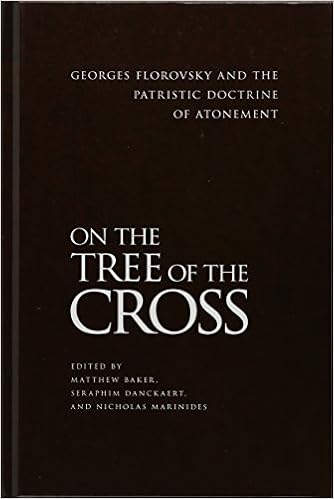
Book Review: On the Tree of the Cross: Georges Florovsky and the Patristic Doctrine of Atonement


On the Tree of the Cross: Georges Florovsky and the Patristic Doctrine of Atonement
Edited by Matthew Baker, Seraphim Danckaert and Nicholas Marinides
ISBN: 1942699093
Price: £23.02 (Amazon UK)

As an admirer of the works of Fr Georges Florovsky and the study of patristics in general, I have been eager to pick up a copy of this text for a while, a recent trip abroad gave me the opportunity to both buy and read this text through, and it was well worth the wait. It contains several great essays by prolific modern thinkers in Orthodoxy and Eastern Catholicism, spanning the centuries of the Early Church and Florovsky’s analysis of their thought.

As an essay collection, the book is split into different sections by different authors based on papers presented at a patristic symposium in honour of Florovsky held at  Princeton Theological Seminary and Princeton University in 2011. These papers each cover a specific thinker’s view on the topic of atonement, along with links between the specific text or line of thought covered and how this view was understood in the work of Florovsky. A large of the text is dedicated to the specific debate between the western substitute view of atonement and the Orthodox ontological view, however this guiding line is demonstrated throughout to be somewhat polemical and not true of patristic thought. The book ends with a collection of Florovsky’s essays, some previously unpublished, on the subject.

As mentioned at the start, I am an admirer of Florovsky’s work and so seeing many current thinkers cover and discuss his work in the text was an enjoyable treat and a reminder of the splendid work being done by Orthodox thinkers in continuing Florovsky’s own patristic studies and the incorporation of the Neo-Patristic synthesis into modern theological questions. I especially enjoyed the sections by John Behr and Khaled Anatolios on Sts Irenaeus and Athanasius, knowing how both are seminal thinkers on these saints it was good to have their views on the matter of salvation analysed at this level. The book also demonstrates the great strives made in patristic study. Overall, the text is a great piece of work, compiling the work of some of the best modern Orthodox thinkers on a difficult and often misjudged area of study, using their patristic knowledge to contextualise the question of Atonement and tackle the various approaches made.

With regards to drawbacks of this book, the only major one which comes to mind is that it often raises more questions than it answers. This is not a flaw in the writing but a general problem which I find with books based on conferences of collections of papers. An example of this comes from its principle point of discussion on the Ontological vs Substitutory view of Christ’s Crucifixion. Due to the essays being from various writers and from various perspectives it gives different answers to the same questions, leaving many readers with no definitive Orthodox view on these matters.

Overall, I would certainly recommend this book to anyone seeking to understand the thoughts of the fathers on the matters of redemption and atonement or with an interest in the ideas and legacy of Georges Florovsky. The book is a great overview of the topic, utilising some of the major Orthodox thinkers and academic writers of this generation to tackle the question with both academic vigour and appreciation of the theological depth of the topic.

Wednesday, 4 September 2013

Book Review: Sweeter than Honey: Orthodox Thinking on Dogma and Truth By Dr. Peter Bouteneff


Sweeter than Honey: Orthodox Thinking on Dogma and Truth
By Dr. Peter Bouteneff
ISBN: 978-0881413076
Price £6.58 (Amazon Kindle Store)

As a book which I picked up purely as a timepass during a recent trip to Trivandrum, Bouteneff's most commonly known work turned out to be a worthwhile investment and one which I finished before the plane even took off. I am a fan of Bouteneff's academically honest writings and accessable writing style, but this book can easily be read and respected by Theology readers across the spectrum.

The book comprises of two sections, one which deals with the Philosophical complexities of defining truth, the other with how the Church forms Tradition around this truth. Both sections are close to 100 pages long and comprise of readable bitesize sections amid longer chapters. This allows the book to be read at a steady pace and entire sections easily found for rereading and academic quoting without sifting through paragraph after paragraph.

The content of the first section, as previously mentioned, is centered around the question "what is truth" and tackles this from a Theological viewpoint, questioning the role of Revelation and scripture in the process of defining truth. This is a good place to start, since it adds to the experience by giving the reader the benefit of understanding what Bouteneff means by truth before entering into the discussion of the Dogmatic side of the book.

The second section is where Bouteneff gets into the real study of Orthodox Dogmatics, looking at the importance of Dogma and the study of theology. This section studies the reason for studying theology, and Church's motives in the development of the Canons and Doctrine. This is further split up into sections explaining why and how certain factors and contributors to the development of Orthodox Dogmatics emerged, making compelling arguments for everything from the Orthodox Exegetical approach to the veneration of the fathers and their works. He also make a compelling case for the polemical language used by the fathers, which demonstrates a fair and academic approach which allows the reader to understand the complexities of reading the fathers.

 As key factors in the understanding of the vitality of Tradition and Dogma to the Orthodox faith, the reasons for their development of the various areas of Orthodox Doctrine and key questions surrounding the,  are covered well by Bouteneff and in a way which is extremely inviting and readable.  Altogether, I could not recommend this book enough. Not only is Bouteneff's writing style one which invites the reader to continue and learn, but the way in which he tackles a topic which can be immensely dry with a vitality which can only be found in a writer who triely values the Traditions of the Orthodox Faith.

Wednesday, 17 July 2013

Book review An Interpretive Account of Belief and Practice in the Ethiopian Tewahedo Orthodox Church. By Abba Haliegebriel Girma.


An Interpretive Account of Belief and Practice in the Ethiopian Tewahedo Orthodox Church.
By Abba Haliegebriel Girma.

ISBN: 97814820008791
Price: £7.16 (Amazon)
 
It is not very common to see a well supported overview of the Tewahedo Orthodox Tradition on major online book stores, especially written in English. Archimandrite Hailegebriel's book comes, therefore, as an unexpected gem amongst a large number of books trying to explain the tradition from an outside and anthropological viewpoint.

The layout of the book contains four sections which cover the structure, doctrines, sacraments and diaspora communities of the Ethiopian Tewahedo Orthodox Church. Considering that the book only spans around 80 pages this is a brave endeavour which generally succeeds in its attempt to give a summary of the Church's stances.

The use of evidence from Scripture and the Church Fathers to support the views is especially well achieved. Almost every aspect of the Faith which is covered in the book is backed up with a Biblical reference to prevent any possible controversy. Many are also placed with explanations from the Church Fathers or the Ethiopian Law of Kings to allow the historical development and practice of Liturgical and Sacramental actions.

Overall the book demonstrates a positive step from the Ethiopian Tewahedo Church, which is sometimes seen as academically lacking in comparison to other Orthodox communities. I would recommend the book to anyone who wants a Theological and Ecclesiological overview of the Church, as it is written for people with a reasonable level of Theological Literacy.

Do not expect an Introduction to the Ethiopian Tewahedo Orthodox Faith from the book, as it is not written for this purpose. If you are looking for a brief overview or reference source for the Tewahedo Tradition, this is certainly recommended. When it comes to Theological studies, It is possibly the best guide to Tewahedo Orthodox teaching apart from primary sources, so certainly something to have in your bookshelf.

Subdeacon Daniel