Showing posts with label canonology. Show all posts

Wednesday, 6 July 2016

Book Review: Spiritual Dimensions of the Holy Canons By Dr Lewis Patsavos


Spiritual Dimensions of the Holy Canons
By Dr Lewis Patsavos
ISBN: 1885652682
$12.00 (SVS Press)

This book was the second of the ‘Birthday Surprise’ texts I received this year from my dear wife and it was a great thing to receive considering that it is a book I have been seeking to read for quite a while now. Following my dissertation, I have felt that I have missed out on Canonology reading and am struggling with the lack of academically respectable texts on the subject available so when I saw Dr. Patsavos’ book mentioned on a few sites I tried to pick up a copy and yet this always evaded me.

The book itself is a short introduction to the role of the canons in the life of the Church. Unlike many other respected Canonology texts it does not seek to do this through giving specific examples of situations but through a detailed study of ecclesiology and mission linking the topics to the Canons and demonstrating the vital role of these Canons in these important aspects in the life of the Orthodox Church.

The book starts as expected with an explanation of the role of the Canons in the Church today and the history of the canonical tradition in the Orthodox church. It does this through looking at the different stages of the development of this tradition and at times making comparison to other concepts of legal tradition such as secular law and Roman Catholic Canon Law. Follow this, it addresses the role of the canons in the life of the Church, especially looking into the role of the canons in the order of the church and the question of their flexibility (A topic I have covered before in articles.) Following this, it addresses a number of issues with regards to the canons such as how the canons can be used to address pastoral issues in the Church and their correct application. The text finishes with a directory of canons and the topics under which they fall.

As a book I will state that this is the best short introduction to Orthodox canonology that I have read. Rodopoulos’ vital text book on the matter is practical and respected as an academic text though as a guide to the canons from a pastoral perspective this text is more beneficial. The text using ecclesiology and the spiritual life of the Church as the basis for its discussion on the canons gives it a vitality and relevance to the reader that the more traditional academic canonology texts lack. As well as this, Patsavos’ discussion of issues in canonology is reminiscent of Fr John Erikson’s writing on the topic, again giving it a relevance beyond a simple explanatory text.

With regards to the weakness, I feel that the text’s length is problematic. In the book Patsavos states how in the next edition he will go into some topics in more detail, such as the pastoral issues. The fact that this second edition has not emerged makes the reader feel that he is only being given half the story. In matters of canonology a certainty in application is needed so to be told when studying the matter that it will ‘be continued’ takes away from the benefits of the text. Regardless, the areas explained are done so in such a manner that this is not damning.

Overall, Patsavos’ book is a great edition to a growing canon (no pun intended) of texts for anyone interested in the study of Orthodox canonology and its application in the Church. It provides a well explained overview of the subject with some clearly employed example and avoids over-legalism or preference towards a single school of canonology in his analysis.  I would certainly recommend it to anyone with a love of the topic or seeking a nice and unintimidating way to enter into its study.

Tuesday, 5 July 2016

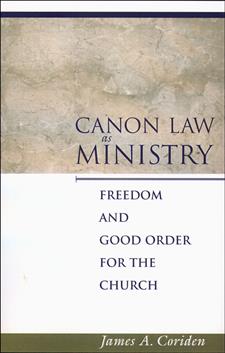
Book Review: Canon Law as Ministry: Freedom and Good Order for the Church By James Coriden


Canon Law as Ministry: Freedom and Good Order for the Church
By James Coriden
ISBN: 0809139782
£9.00 (St Philip’s Books)

As something on a Canon Law enthusiast I decided to spend my birthday gift voucher exploring the western tradition of Catholic Canon Law and was advised by a friend of similar interests to pick up some works by James Coriden, a much respected Catholic Canonist. This led me to pick up the text and start some exploration into this section of canon studies. A quick note on this text, it is designed for the Canonist and not for a general introduction to Canon Law in the Catholic Church so in my final paragraph, I will not be recommending it for general reading. This is not a criticism of the book, just a quick point before people who read this review start saying how they will add it to their reading list.

From the start, Canon Law as ministry sets outs its aim clearly. It is written with the purpose of saving the reputation of the canonist from the wave of infamy which has engulfed canonology since Vatican II. Coriden makes it clear that he feels that Canonists have been given a bad reputation since the Catholic Church’s shift in emphasis at the Council from the more tradition concept of Christian morality to the somewhat vague conscience based system. Coriden states his concern that this has led to Canon law becoming seen as an outdated and archaic practice and the text gives a clear outline to the canonist as to how the concept of Canonology is still a vital part in the Catholic Church today.

Now I am by no means an expert on Catholic Canonology though with my academic research area being Orthodox Canonology I felt the text was a good place to start to gain an understanding of Western Canonology since it is designed to put the area into a modern context and it does this very well with clear links made to both local issues in the parish and wider issues which encompass the entire Catholic Church. The book starts by giving an analysis of the current debate over Canon Law. This section was fascinating since it sets out the different schools of Canon Law clearly and explains their development well. This struck a chord with me as in the Orthodox community there are also various different schools of canonology and it was interesting to see how many of the Catholic approaches tend to fit well with some of the Orthodox ones and how the Codification of Canon Law in the west has led to the development of a wider variety of schools of Canon Law.

Following this, Coriden gives a historical and theological overview of Canon Law. This section was one which I found quite disappointing since it only covered the Canons from the Biblical perspective of law and their codification, almost deliberately missing out the centuries of the use of the Canons as guidance as opposed to a codified legal system. This is of no consequence to the message of the text though, as it moves on to analyse the role of Canon Law in the Catholic Church today, especially its role as granting assistance in dealing with issues of freedom and also in promoting good order in the Church. The book finishes with an explanation of the place of the Canonist as a minister and Canon Law itself as the ministry of the Canonist, again setting out the emphasis of the remaining vital place of Canon Law in the Church.

The main strength of the book comes from Coriden’s writing. You can see that he is a firm believer in the vital place of Canon Law in the Church and this comes across in his style. From Coriden’s use of his local parish Church to demonstrate the practical benefits of correct canonology for the people to his grand scale dream of the vindication of the canonist, the text is most certainly a heartfelt pledge for understanding. In the same way he refers to the documents of Vatican II constantly to evidence his message of the relevance of canonology.
On the other hand, Coriden’s conciliatory approach to the topic seems to undermine the message. In this the text Coriden seems to willingly accept the watering down of Canonology at times and spends much time emphasising the conscience as a supreme moral guide. Though I appreciate this point as sensible, especially in the modern Catholic Church, it seems to backstep when the point of the book is to demonstrate that the Code of Canon Law can still be applied in a meaningful way when the claim is followed by the clause of it being ultimately up to the individual.  

Overall, I found the text to be an interesting introduction to the issues surrounding Canon Law in the Catholic Church, especially when many of these issues are not found amongst the uncodified concept of canonology in the East. Coriden raises many issues in the text which remind us of the importance of the Canons as a form of ‘measure’ of the faith and as guidance and is able to give some beautifully well thought out defences of the art of Canonology in an age of relativity and moral personalism. 

I would recommend the book to students of Canon Law, especially those living in the West or looking into the struggles between Canonology and modernity. As previously mentioned I do not feel that it would be an appropriate text as an introduction to the canons or for someone curious on the matter without proper understanding of the subject. This is not a criticism of the text, since it does not set out to introduce to the topic, however Coriden’s aim is to speak to the Canonists of this generation and therefore as a text it is certainly to be left to the Canonist as intended.