Showing posts with label god. Show all posts

Thursday, 3 January 2019

Tolkien, Meekness and the Christian Message of Hope.


We must take a hard road, a road unforeseen. There lies our hope, if hope it be.”
Tolkien, Meekness and the Christian Message of Hope.


 The title of this post may be a bit confusing, so before I start I will explain. Having spent the last year agonising over what to write about, I stepped back and decided to get back into reading. One of my favourite genres is ‘High Fantasy’ and specifically the writing of JRR Tolkien, with his blending of his faith, life and interests into his writing. Having recently rekindled my love of his Lord of the Rings series, I was reminded of an important theme, the theme of having hope. Since today also lands on the Birthday of Tolkien, I thought it apt to write this short reflection.

In the Christian faith, we hear of the term hope constantly, with the emphasis on God’s great love for us in the action of the Incarnation. This is expressed well in the First Epistle of Peter, in which we are reminded that God, “was manifest in these last times for you,  who through Him believe in God, who raised Him from the dead and gave Him glory, so that your faith and hope are in God.However, unlike the traditional concept of the provision of hope in an almighty God, the Christian message of hope goes a step beyond and presents its message of hope through two unimaginable images; his birth and his eventual death. 

Interestingly, in Tolkien’s “Lord of the Rings” this theme of hope promised through the unimagined is often expressed in a way that is highly relatable to Christians today, as it is expressed as coming in the meekest of beings and the darkest of journeys. To me, one of the greatest expressions of this hope is found at the Council of Elrond. For those who have not read the book, this is an event in which the Free peoples of Middle Earth meet to discuss what to do upon discovering the Ring of Power, which is a weapon of pure power and evil, often symbolic of sin or corruption which gives power but ultimately destroys. Because of this, it is decided that the only possibility is to destroy it, by entering the land of Mordor, where the enemy resides. “We must take a hard road, a road unforeseen. There lies our hope, if hope it be. To walk into peril – to Mordor. We must send the Ring to the Fire.” In this we already see the resemblance to the Christian concept of Christ’s death and resurrection. 

In both cases, hope is found in the darkest of situations through something which we would not usually seek as a form of hope. In the case of Middle Earth it is found in entering the very home of Evil, in the case of our faith it is found in the Death of Christ on the cross. As John Chrysostom stated in his Paschal Sermon, Let no one fear death, for the Saviour’s death has set us free. He that was held prisoner of it has annihilated it. By descending into Hell, He made Hell captive.”  This expression of faith would seem utterly baffling to one outside of Christianity, however it is in this that we find the core of our faith as a truth. Because of this, the concept of death becomes a promise of eternal life to Christians, as the death of Christ allows us a Salvation which we were promised, in the same manner as those attending the Council of Elrond found their Salvation only through the journey into the lair of their enemy.

The message of such a hope is vital to Christians today, since we are expected to take leaps of faith and take up our struggle in all we do. Christ reminds us in the Gospels, “If anyone would come after me, let him deny himself and take up his cross and follow me. For whoever would save his life will lose it, but whoever loses his life for my sake will find it.This becomes even more prevalent when we witness the dedication to their faith of the many Martyrs of both the Early Church and even today. In this, the realisation of the call to the promise of eternal life becomes a reality and the hope of life after this becomes something to hold onto regardless of circumstance. It is this very fact that makes it so profound. Knowing that our salvation came through Christ’s passion and resurrection gives hope that God is there, and that even in the darkest of times there is a light and that that light is God.

In the same manner, the idea of the Incarnation itself and gift of hope through Jesus Christ was something of a scandal in the ancient world, especially in the manner of his coming; St Athanasius reminds us that, “The Lord did not come to make a display. He came to heal and to teach suffering men.” In this we see that hope came in Christ in the humblest of manners. During this time of advent this message becomes even more prevalent, and we are taught of the nativity of our Lord being born not in a Palace as a King but in a manger where animals feed from. St john Chrysostom expresses this in an emphatic manner in his nativity Sermon, stating, “What shall I say! And how shall I describe this Birth to you? For this wonder fills me with astonishment. The Ancient of Days has become an infant. He Who sits upon the sublime and heavenly Throne, now lies in a manger.” In this we see the scandal of hope coming through the meekest of means.

This theme is again taken up by Tolkien, through his main protagonist who is a Hobbit (Halfling) named Frodo. As all of the races are arguing over who will destroy the ring he volunteers to take up the quest and he expresses his meekness by stating, “'I will take the Ring,' he said, 'though I do not know the way.’ In this we see the reminder of the smallest of beings doing what none other could. This message again is emphasised when it is stated, “such is oft the course of deeds that move the wheels of the world: small hands do them because they must, while the eyes of the great are elsewhere.” This resonates with the message of the Incarnation, that the lofty and prideful will not seek Salvation in what they perceive as lesser, an attitude which we see throughout the Gospels through the Jewish authorities refusing to accept Christ due to their pride and greed.

This message again is a vital and important practical message for Christians, since God has condescended and became man for us, offering up himself as man that we may come to know him and receive Salvation. St Paul expresses this, stating how he, “did not regard equality with God a thing to be grasped, but emptied Himself, taking the form of a bond-servant, and being made in the likeness of men.” This can again link to the message of the Resurrection that he died to defeat death, in the same way he came to us to help us come to him. In living out this in our lives we are given a living example of how to live meekly and in humility. Even beyond this we are offered a promise of Salvation, reminded that the meekest and lowest of us can be the bearer of hope to others.  
Overall, we are offered two key images of hope, neither of which would traditionally inspire in us the idea of a promise of Salvation or Hope. However, we know that it was through the birth of the Child in the Manger and his harrowing Death on the Cross that hope was returned to us with the promise of Salvation.  At this Advent time this is a stunning image and one which is at the centre of our prayers.

To quote Tolkien one more time, “This is the hour of the Shire-folk, when they arise from their quiet fields to shake the towers and counsels of the Great. Who of all the Wise could have foreseen it? Or, if they are wise, why should they expect to know it, until the hour has struck?” Or to put it simply, Hope is found in the most surprising of places but it is always hidden in plain sight.

Tuesday, 21 November 2017

Female Ordination and Orthodox (re-posted from 2011)


In Orthodoxy, following the traditions of the Early Church fathers is just as important as following Scriptural teachings, after all, if you want to get to the spirit of an idea, the earliest understanding of it is most likely to be the least corrupted. So in knowing that the Early Church was willing to ordain people of all races (Christs apostles were not all israelites, yet he Ordained them to lead the Church after his ascendence, and they, through the holy spirit's guidence, did the same after this.) we also know to accept all ethic backgrounds into the clergy as Christ himself, and his apostles did. This was not the case with women, as there are no records of women in the early Church being ordained. therefore following the traditions of the Early church means not ordaining women.

Where does the idea of a male only clergy come from? The idea originated from the bible, and to be precise; Christ himself. The concept of female ordination is an extremely modern one, and is not down to “the male dominated society of the time,” not a sexist idea, and not designed to keep women down.  It is simple down to common sense.
One commonly mentioned factor in this is what the clergy are. The clergy are, in the Orthodox tradition, the image of Christ to the congregation.  This is why the ordination of Clergy is such an important sacrament in tradition. Going by this we need to look at what the image of Christ entails: By accounts of all Old Testament prophecy and the very revelation as recorded in the Gospels, the Christ was male. This means that the image of Christ is also a male image. To many this may also bring up the Question of race, since in the west Christ is a white male. What does this say about the Ethnicity of the "Icon of Christ"?

To answer the question, fortunately the Orthodox Church has not had to deal with this issue due to the large spread of the Church at its founding (Turkey, Egypt, Ethiopia, India, Syria, Rome and Greece all being preached to at the time) and there have for the last 1700 years at least been known and universally venerated icons depicting Christ as being from all these places. An Icon of the Theotokos (St. Mary) I have in my house depicts her as Egyptian and is placed next to a Greek Christ Icon. As well as this, an Icon in our Bournemouth Church has Christ as an Ethiopian, as it was written by an Ethiopian Icon writer.

The race of Christ, at least in the Orthodox Church, has never been an issue. This is quite simple as the bible states this, as well as his gender and many details about him in the Gospels and writings of Early Christians (and Greek historians). We know was an israelite (a semite in scientific terms. His apostles themselves were of, and made priests of many from places such as Egypt, Ethiopia and Antioch (Syria), and even St paul is described as being of Egyptian Heritage( Acts 21:38 "Art not thou that Egyptian?") So race is not something to be made a big deal of, as the tradition has not come down through a specific race as a medium.

Race has sometimes been an issue in Western Churches, I have seen too many Americans with "God Loves America" "God Hates Arabs" etc... on their shirts, cars and everywhere else they can fit them to ever disagree with that. But as a white, British Born member of the Orthodox Church of Egypt (The Coptic Church) I cannot see how this could ever touch Orthodoxy, being that I have "Brothers" and "sisters" in Ethiopia, Russia, Egypt, India and most of the Mediterranean since the first centuries of the Church's existance.

This, compared to the female ordination debate is again a simple matter of Tradition. As God chose in Christ a male body to preach to mankind in, then chose male apostles from amongst his male and female followers and then they, the founders of the Church, (the apostles) ordained priests from all over. According to Tradition and Scripture this was all led by the Holy Spirit, (which they were blessed by) yet they were never led to Ordain women as priests, even when preaching in nations where other faiths did (such as the greek islands), so this is what is traditionally the way.

A second reason why in Orthodoxy a female clergy is seen as an impossibility is the very nature of the Orthodox Church. The Orthodox Church is by all accounts a Church which prides itself on the (As Bishop Kallistos Ware calls it) “unvarying practice of the Church over the past two millennia.” With this in mind, why would a Church which practices the Christianity of the Earliest Christians decide to adopt a modernist, somewhat secular outlook? We have seen the Catholics start this with Vatican II, and the protestant Churches have done this since their creation (The very name “protestant” gives off an image of someone pushing away). The fact remains that in Christianity, modernisation and secularisation are everywhere, but Orthodoxy refuses to be drawn in.

According to Fr Seraphim Rose, a Heiromonk and writer of the Serbian Orthodox Church in America, “Even Heresy has its own ‘spirituality,’ its own characteristic approach to the practical religious life.” In other words, even someone wrong may have answers; this does not mean they are right. In his book Orthodoxy and the Religion of the Future” he quotes the philosopher Ivan Kireyevsky, saying “An Orthodoxy Mind stands at the point where all roads cross. He carefully looks down each road and, from his unique vantage point, observes the conditions, dangers, uses, and ultimate destination of each road from a patristic viewpoint.” So in order to obtain a truly Orthodox mind one must take a road which will lead to God, and not to a peace with anything else. Not even comfort within the modern secular world is worth losing that peace with God for. We have seen monastics give up the comforts of the secular world for God, and as Christians are asked to do the same.

This concept has a great influence on the Orthodox mindset, as we are not called to change for the world around us, but to stay strong in God alone.  This is why tradition is so important to the Orthodox Church, for as so many have swayed into heresy and changed to “go with the flow” the Orthodox Church has, without apology, stuck to its guns and refused to fall into the world and all its passions. This also goes for the concept of female Ordination. We see in the Gospels how Christ picked his disciples, the 12 Apostles. Christ, actively chose men as his closest followers, though he did have female followers. These 12 were given the power to trample underfoot the power of the enemy, and understood Christ’s message, spreading it across the world, no other was given the strength to do this. From this tradition we see that Christ could have chosen women to lead his church, but instead chose men, though we do see women the deaconate in the early church.  To the non Orthodox mind this may come as placing women in an inferior, servant position, yet to  Orthodox Church it I simply the way in which God chose to organise his church.

Again to the non-orthodox mind this idea of women as the servants of the Church and men as its head would seen a bit out of touch with “modern feminist thought” but many forget the great female saints and Martyrs such as St Faith, Saint Maria and St Bebaia or even the great desert mothers and famous nuns of the Orthodox tradition whose writings and love of God have been recorded throughout time as great wisdom. Even above these is Gods greatest Human Creation, the Mother of our lord, Saint Mary, the Theotokos, the Mother of God. Many Orthodox prayers are said in her name, she is prayed for in the hours, and revered above all.

In conclusion, the place of women in the Orthodox Church is not a matter of sexism; it is a simple matter of God over man, or tradition over change. There is no “anti women” agenda in the Church as so many seem to think, as Stanley Harakas stated in his The Orthodox Church: 455 Questions and Answers book “it is not accurate to label this tradition as “anti-woman” and to charge the Church’s teaching with anti-feminist. To say this is an unfortunate misunderstanding of the purpose of the church and its primary interests.”  He goes on to explain how though many in the church have spoken out about such things as temptation and targeted women, other women have been praised for their chastity and wisdom, so to say the church is anti women because it is against certain types of behaviour from women is to call it anti-food because of fasting. These concepts are both preposterous and again miss the point. The same goes for  the idea of Sexism due to an all male clergy. If you associate following a tradition without female clergy with being ”anti female” you miss the point of that tradition.

Friday, 25 August 2017

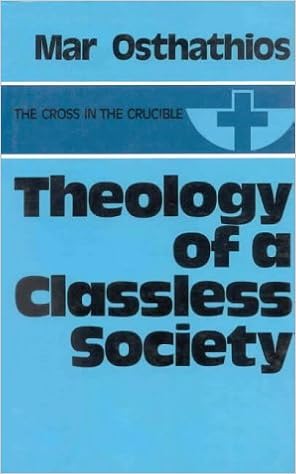
Book Review: Theology of a Classless Society By Dr. Geevarghese Mar Osthathios


Theology of a Classless Society
By Dr. Geevarghese Mar Osthathios
ISBN: 0718824156
Price:  £89.95 (Amazon UK Marketplace)

I had been planning to buy and read this text for a number of years to have a further understanding of Mar Osthanasios’ political philosophy and his theological justification of it. Since in the summer I was visiting Kerala, I thought to take the opportunity to read this text since it is seen as one of his most famous works. As well as this, the text is often cited as an important English language work from the Indian Orthodox, especially with regards to concepts of social justice. With these in mind, I felt it important to read and understand.

The book is presented as an explanation of Mar Osthasios’ theory of the possibility of a classless society, demonstrated as Christian through use of theological examination with plenty of reference to the coequality of the trinity and Christ’s teachings on community. It is divided up based upon themes, from the outline of the theory, its application, to its theological justifications, with most of the book dedicated to the theological justification. Following on from this, Mar Osthasios gives a short question and answer section of the theory as well as a justification for his trinitarian terminology use which he states in the text as controversial.

Though I struggle with the premise of the book, a good strength of it is its resourcing. Mar Osthasios, having been educated under some of the most prominent Orthodox thinkers and secular philosophers of our time, puts a great deal of research into the sourcing and referencing of his work to support his theory. As well as this, the importance placed on the justification of his theory gives the book a sense of respect since regardless of your view on the theory you can sense the passion of the writer and it often draws you in. Though both of these are important points, I feel the greatest strength of this book is the writer’s awareness of the issues which people could raise with his theory. There is no sense of arrogance in the text, which is a rarity in political theology and many theological text. Mar Osthasios knows some people will scoff at the idea or at his theory’s application but wants you to know why he believes it. 

The major difficulty for me with this text lies in the theory itself and the way it is displayed. Though I admire the rigor and passion of Mar Osthasios in presenting his theory, I still feel that it is simply presented as a Christian Communism and is drawn too much on his admiration of communism as opposed to the theological and ecclesiological foundations it is claimed. An example of this comes in his ideas of application. He often compares his view to Liberation Theology and throughout the text he states his admiration for key thinkers of the movement without addressing its issues Theologically. He also states that he does not see communism as an answer since it is secular, however he then speaks in praise of Mao for being used by God as a tool to develop ideas of a classless society, comparing him to God’s use of Cyrus for the return of the Jews from exile without justifying the false equivalence here. 

The problem with this is that the Theological aspect seems to be simply a coating for the theory rather than its foundation, as demonstrated in his tracts on Jesus’ life and its links to a classless society, which would have given a perfect opportunity to evaluate the communist links in a more theological level but instead leaves them uncontrasted apart from the general “but that is secular” comment. As well as this, the Theological examples used are often vague and even risking heresy, which Mar Osthasios even admits when addressing his almost tritheistic view of trinity. To me this makes the book suffer greatly, since it slowly seems to reveal itself as less of a ‘Theology of a Classless Society’ and more of a ‘View of a Classless Society with a dash of Theology.’
Overall I would say that the text is a good one for looking at how Christian thinkers have attempted to address the issue of clearly unfair social practices and problems they have faced, however I cannot recommend it as a viable foundation to a theory of political theology since it fails to address a number of issues both theologically and politically which I feel undermine the theory and make it appear a simple communist text with a light coating of theology, one which has been seen in the past and has not seen itself aligned with the Ecclesiological or Theological standings of the Orthodox Church.

Sunday, 19 February 2017

Book Review: Coptic Christianity in Ottoman Egypt By Febe Armanios


Coptic Christianity in Ottoman Egypt
By Febe Armanios
ISBN: 0190247223
Price: £17.27
Febe Armanios’ book is one that I had been looking forward to reading for (literally) years. Whilst writing my Mth Thesis on the development of the Coptic Papal Election system one of the great difficulties was a lack of academic writing on the Coptic community during the Ottoman Era, and this text fills in the gap nicely, using sources from both Ottoman and Coptic records to give a broader understanding of the historical period and the community relations therein.

Armanios’ writing takes a thematic approach to the topic, looking at specific themes and historical instances during the Ottoman Era in Egypt in order to gain an insight into the place of the Coptic Church in society as well as the allowances and practices of the community in the Ottoman yoke. The text starts with a look at the sources available to us to do this, and raising the issue of lack of available sources to academics. It goes on to look at martyrdom stories and their impact on the community, pilgrimage and the development of rights and finally to cover the use of sermons to define Coptic identity during conflicts with missionaries from the Catholic and Protestant communities.

The structure of the text and its great insight into a very loosely explored period in Coptic history allows this book to demonstrate some great and original research into themes which have not been looked at. As well as this, Armanios’ approach to the topic and the readability through which she expresses her research allows the reader to access a vast historical landscape in an easy manner. This readability and originality makes Armanios’ book a great read and certainly one to be recommended to anyone with an interest in Coptic history or general Ottoman studies.

As for any weaknesses, the main one is one which Armanios herself addresses in the book. In the introduction she states that due to prejudices with regards to the period and a general lack of scholarship as to Coptic communal history the text can only give a broad overview of the period without delving into any of the subjects in further detail. Therefore to any specialist reader looking into a certain aspect of Coptic history or Ottoman history in Egypt it can seem too loose in areas, though this is not the fault of the writer but simply a symptom of a lack of academic resources available.

Overall, I thoroughly enjoyed the book. As mentioned, it is readable and original in its scholarship which allows it to be a text with a lot to offer the reader. I would recommend it to anyone looking to fill in this much misjudged gap in Coptic Historical studies and anyone with an interest in the development of modern Coptic society generally.