Sunday, 22 November 2020

Discussing Orthodox Faith: Audience and the dangers of pre-packed evangelism


Originally posted on CopticNN

Someone I often notice when speaking of my personal journey to the Orthodox faith is that people do not hear what they expect to. A number of years ago I attended a converts group and explained how I came to faith through philosophical enquiry and was told, “we don’t want to hear about philosophy, when did you open your heart to Jesus?” Needless to say, I didn’t attend the group again. However, this incident raises an interesting challenge regarding the expression of our faith to others, and that is the risk of alienating them through not speaking to their need.

In my own secular life, I work as a teacher, and the question of differentiation comes up often in my planning. We are trained to ask, ‘what level are you teaching to?’ and ‘How does the lesson link to prior learning?’ In the same manner, we need to ask the same question when speaking about our faith or trying to present it in a manner which would be meaningful to others. After all, what benefit is it to speak of the marvel the crucifixion to someone who hasn’t come to terms with the concept of the salvation it brought. Similarly, we would not spend the majority of our energies convincing a well-studied catholic enquirer of the importance of the fathers or apostolic succession. Therefore, we need to step away from the presumption that a ‘pre-packed’ view on evangelism or the position that all come to Christ in the same way,

Let us take two examples and compare these. Imagine that you have a visitor to your parish who has come from a Pentecostal background and left due to a family issue, they would be seeking to find community and a church which can provide comfort. They may also face difficulties in areas such as the veneration of the Saints, or the use of Icons in the Church. This means that anyone helping with their catechesis will need to adapt their approach to these specific needs through themselves having a comforting approach and a depth of understanding of these issues. In a similar way, if there were to be someone coming from a non-religious background and seeking to become Orthodox following some personal epiphany regarding the faith. This person may have background in addressing philosophical questions and need their entire understanding rebuilt from the ground up and need to address tough questions on theological challenges such as the nature of God. Similarly approaches may differ based on someone’s prior theological education or their own prayer life, both of which impact the approach the Church should take when introducing someone into the Church and catering for their development.

As both of these examples show, the view that someone’s spiritual and catechetical development can be presumed is an absurd one and one which the Church needs to address, otherwise we risk falling into the common danger of ‘prepacked evangelism’ which we see often amongst some communities who will take a generic and often impersonal approach to their introduction of the faith to others. This is also something we often see in our own communities where an enquirer whose needs or questions are not answered will be blamed if they do not attend again or lose their way in their journey of faith. However if we are to take an intelligent approach to this challenge it can be solved by looking to the example of Christ in his interactions with people of differing backgrounds and foundations in their faith.

In John 4 we see Christ’s interaction with the Samaritan woman, in which he refers to her concerns over the Jewish/Samaritan schism in a manner which gives us pause to think. When she asks, “You are a Jew and I am a Samaritan woman. How can you ask me for a drink?” (John 4:9) due to views on ritual purity he responds by pointing out, ““If you knew the gift of God and who it is that asks you for a drink, you would have asked him and he would have given you living water.” (John 4:10). In this manner he addresses her concern though raising his divinity, leading to a discussion on his teachings and the nature of salvation. Following this he calls her to him through speaking of the end of this schism through the person of Christ, stating, “a time is coming and has now come when the true worshipers will worship the Father in the Spirit and in truth, for they are the kind of worshipers the Father seeks.” (Jhn 4:21). In doing this there is no dismissal of either her previous views nor a vindication, but a catering to the discussion she needed for her salvation. Applying this to the modern challenge in evangelism in a multi-faith society, we need to ask “what is their prior understanding? What needs to be stripped away, and what can be built on?” In this manner we can both take down any misconceptions and build up and need for development based on the manner of someone’s prior learning.

In its missionary and evangelism work, the Coptic Church has made strives in its approach to bringing faith to other communities and growing in the multi-faith and often postmodernist world, however without ensuring that the evangelism that appears is catered to the recognition that diversity is not simply intercommunal but also intracommunal it is bound to hit a brick wall. If we cannot speak to the individual and their own experience in our attempts to bring others into the Church, we will struggle to bring anyone into the Church. In the same manner, if we cannot cater to the individual needs of the person coming into the Church, we should not be surprised if they seek it elsewhere.    


Discussing Faith: Culture, language, and the modern Areopagus.


Originally published on CopticNN

As Orthodox Christians, we often bemoan the state of our missionary work in countries unreached by the faith, however these efforts have been growing recently, with missions and parishes emerging in the far-east, sub-Saharan Africa, and South America.  Recently I had the blessing to speak with a missionary association in Cairo, discussing the challenges facing those travelling around the world to share their faith, and how to counter these. One of the biggest challenges discussed was regarding cultural dialogue and the challenges of expressing the Christian faith in communities where even the most basic Christian theological terminologies were not a part of the vernacular.

Though this may sound like an obscurity, when we look at prevailing theologies outside of those areas occupied by Abrahamic faiths, we see the challenge facing those whose role it is to express our apostolic faith to others; it is often seen as being incompatible, at a theological level, with the local culture. Because of this It becomes the role of the missionary to develop a theological dialogue between themselves and an audience who have no shared concepts or vocabulary to base their discussion on.

Let us look at an example. Imagine an orthodox missionary were to travel to rural Mongolia, armed with a collection of materials and a fluent understanding of the local language. They would have the capacity to explain their belief but not to translate these in a sense that would permeate in a culture whose religious literacy is tied up largely in Buddhism and native shamanism. The challenge would no longer be one of how to begin a discussion but of how the discussion can be understood accurately and in a meaningful way. Even concepts which we largely take for granted in discussions, such as the concept of a personal (relatable in some sense) God, may become far more difficult to express to someone whose concept of God is impersonal or whose faith is traditionally deistic. In the same manner we would be required to address concepts far beyond this such as trinity, incarnation and eschatology, without risking falling into creating our own theologies or misrepresenting them.

The western Philosopher Ludwig Wittgenstein discussed this challenge in his theory of Language Games. He implied that the vast majority of philosophical disagreement is grounded in the differences in use of terminology and that, “Philosophical issues arise when language goes on holiday.” To get by this issue one would be expected to understand the rules and terminology regarding discussing that subject, like someone would be expected to understand and play by the rules of chess when in a game of chess. In the same manner, if someone were to engage in a theological discussion with someone whose only understanding of religion comes from non-theistic or deistic traditions they would be expected to discuss things in a way that would be meaningful to their audience, otherwise the discussion would be fruitless. This is exactly the challenge faced by missionaries, not the ability to discuss faith, but to have it understood in a meaningful way.

This dilemma may imply that I feel missionary work in such cultures is futile, however I for one relish the existence of this challenge and recognise it as having been one which the Church (both our Oriental Orthodox, and the Eastern Orthodox) have had to face in the past and have done so before. In the case of the Eastern Orthodox we have examples such as Cyril and Methodius who literally developed a new alphabet to allow Slavonic communities to read the Gospel. However, the greatest example can be seen in Acts 17, where St. Paul discusses the faith with Greek philosophers, applying their own terminologies and sentiments to demonstrate the nature of God, bringing many to the faith.

St. Paul’s Areopagus sermon is the perfect example of knowing your audience and their culture, allowing St Paul to engage fully in their discussions and bring them to the understanding of the faith. If we break this sermon down, we will see this in its entirety. St Paul begins by discussing their forms of worship and beliefs through the inscription to the ‘Unknown God.’ And explains, “the One whom you worship without knowing, Him I proclaim to you: God, who made the world and everything in it, since He is Lord of heaven and earth, does not dwell in temples made with hands.” (Acts 17:23) in doing this we see him acknowledge the personal nature of their previous theology and apply it to his words regarding the Christian faith. Following on from this, he explains to them the errors of applying their worship to this theology, using the shared belief regarding the nature of God as his basis, allowing understanding and agreement. We also, in this instance, see an area where there is no shared basis, when we are told, “when they heard of the resurrection of the dead, some mocked, while others said, “We will hear you again on this matter.” (Acts 17:32). However in this instance, many seem to wish to continue to hear and understand, thus giving St. Paul his opportunity to continue to share based on his willingness to reference their beliefs and use them to explain the Christian faith and its truth.

With the example of St. Paul in the Areopagus, we see both the challenges and rewards which missionaries can face when expressing the faith to others. By using and referencing the ‘Unknown God’ and how He is known through Christ, St. Paul was able to win many to the faith, however he also recognised the challenge of expressing belief in an afterlife to those who do not recognise the post-mortem existence. It is in matters such as these that the modern missionary will look to establish a shared understanding of language on the nature of body, soul and spirit where available. However, topics of eschatology remain something of a challenge to express even to those within the Church at times.

Overall, the challenge of filtering the truth of our faith through differing cultural contexts is one which the Church faces increasingly as it looks outwards to missions in cultures with no prior understanding or exposure to Abrahamic faith, and especially to Christianity. However, through recognition of the need to work within the bounds and rules of the prior language and cultural or religious landmarks of those we are seeking to bring to Christ, we can break down the language barrier and allow for a more meaningful and thorough dialogue, deepening the love of Christ in those we wish to welcome into his Church. Christ called us to bring all nations to him, this will always seem a daunting task but once the first wall is broken between the Church and those it seeks to welcome, others will seem much smaller.


Sunday, 24 February 2019

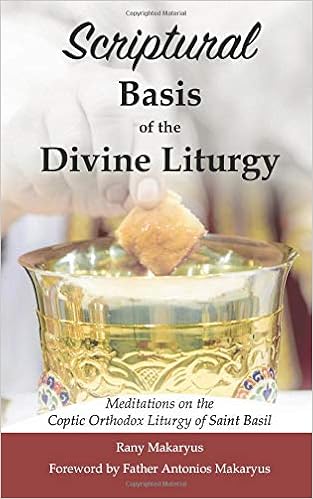
Book Preview: "Scriptural Basis of the Divine Liturgy" by Rany Makaryus


“The Scriptural Basis of the Divine Liturgy: Meditations on the Coptic Orthodox Liturgy of Saint Basil”
By Rany Makaryus
Price: £6.95  (Amazon UK)
ISBN: 1732891818

Today’s blog post will be slightly different to the usual. Instead of reviewing a book, we have the blessing of hearing from the author. Rany Makaryus’ book “The Scriptural Basis of the Divine Liturgy” is a wonderful introductory text to liturgical studies, exploring the scriptural links between the Liturgical prayers of the Coptic Orthodox Church and Scripture, as well as the origins of our Liturgical practice found therein.

So here is what Rany had to say:

“Do you remember the last time you focused on what was being recited in church before taking communion? It is very hard to focus on that. We always have so much on our minds as we stand there stressed out about work, conflicts with others, problems we are facing, and pending tasks we need to complete. Besides the stress, any little thing happening around us so easily distracts us¾just a small alert from our phone can send our minds off in many different directions. Worse is that it seems we have become rather immune to the many prayers that are recited on a weekly basis.

Growing up going to church on a weekly basis and being the smart aleck kid that I was, I liked to ask annoying questions such as, “If Jesus said that we should not use vain repetitions in our prayers, then why do we repeat prayers so many times during the liturgy?” Similarly, we might ask why the prayers in church are so long and drawn out. This might be the case in many different churches, but it is particularly true about the Coptic Orthodox Church. If you've ever been to one of our liturgies, you will realize just how long this could take. The shortest I’ve ever seen is at least 2 hours from when the service begins to when we heard the words “Go in peace.” Much happens in that time, and if we really care to know the answers to these questions, we should diligently try to understand what is being said and done.

The Coptic Orthodox Church presents us with many rich traditions and prayers that are meant to keep us rooted in the true faith.  In fact, as much as the liturgy is meant to prepare us for receiving Holy Communion, it is also a way for us to learn about our faith. There is so much that a believer can learn about Christianity simply by attending and paying attention during the liturgical prayers on a weekly basis.

When I started to dig deep into understanding why there are so many prayers, why they are all so important in preparation for receiving this sacrament, and how they were all put together in the form that we now have, it became very clear that these prayers have one main source, and that is the Holy Bible. I was most intrigued by the words of Saint Paul to the church in Corinth about their church gatherings saying, “For I received from the Lord that which I also delivered to you...” (1 Cor 11:23). This phrase indicates that this tradition of breaking the bread and sharing in communion with one another¾receiving the Body and Blood of Christ¾was instituted by Christ Himself. We can further extrapolate from this that this tradition was preserved by the church and passed down to us through the past 2 millennia. Further evidence of this is that different churches throughout the world, many of which have not maintained much communications for centuries, currently have very similar phrases used in their prayers.

How is it that these prayers can be preserved, not only through time, but also throughout many different cultures and traditions around the world? The reality is that this is mainly because these prayers have their roots in the scriptures that we all hold so dear to our faith. This was the principle inspiration for me as I put together my findings, leading to writing the book Scriptural Basis of the Divine Liturgy: Meditations on the Coptic Orthodox Liturgy of Saint Basil. Though it might be hard to focus on the prayers during the liturgy, if we really want to take our faith seriously, we should strive to understand the meaning behind these prayers that we hear on a weekly basis. Hopefully, with this new year, we can take a renewed focus on the liturgy and the depth of meaning we gain from it. “

Scriptural Basis of the Divine Liturgy is available now on Amazon UK:


For kindle version:

Thursday, 3 January 2019

Tolkien, Meekness and the Christian Message of Hope.


“We must take a hard road, a road unforeseen. There lies our hope, if hope it be.”
Tolkien, Meekness and the Christian Message of Hope.


 The title of this post may be a bit confusing, so before I start I will explain. Having spent the last year agonising over what to write about, I stepped back and decided to get back into reading. One of my favourite genres is ‘High Fantasy’ and specifically the writing of JRR Tolkien, with his blending of his faith, life and interests into his writing. Having recently rekindled my love of his Lord of the Rings series, I was reminded of an important theme, the theme of having hope. Since today also lands on the Birthday of Tolkien, I thought it apt to write this short reflection.

In the Christian faith, we hear of the term hope constantly, with the emphasis on God’s great love for us in the action of the Incarnation. This is expressed well in the First Epistle of Peter, in which we are reminded that God, “was manifest in these last times for you,  who through Him believe in God, who raised Him from the dead and gave Him glory, so that your faith and hope are in God.” However, unlike the traditional concept of the provision of hope in an almighty God, the Christian message of hope goes a step beyond and presents its message of hope through two unimaginable images; his birth and his eventual death. 

Interestingly, in Tolkien’s “Lord of the Rings” this theme of hope promised through the unimagined is often expressed in a way that is highly relatable to Christians today, as it is expressed as coming in the meekest of beings and the darkest of journeys. To me, one of the greatest expressions of this hope is found at the Council of Elrond. For those who have not read the book, this is an event in which the Free peoples of Middle Earth meet to discuss what to do upon discovering the Ring of Power, which is a weapon of pure power and evil, often symbolic of sin or corruption which gives power but ultimately destroys. Because of this, it is decided that the only possibility is to destroy it, by entering the land of Mordor, where the enemy resides. “We must take a hard road, a road unforeseen. There lies our hope, if hope it be. To walk into peril – to Mordor. We must send the Ring to the Fire.” In this we already see the resemblance to the Christian concept of Christ’s death and resurrection. 

In both cases, hope is found in the darkest of situations through something which we would not usually seek as a form of hope. In the case of Middle Earth it is found in entering the very home of Evil, in the case of our faith it is found in the Death of Christ on the cross. As John Chrysostom stated in his Paschal Sermon, “Let no one fear death, for the Saviour’s death has set us free. He that was held prisoner of it has annihilated it. By descending into Hell, He made Hell captive.”  This expression of faith would seem utterly baffling to one outside of Christianity, however it is in this that we find the core of our faith as a truth. Because of this, the concept of death becomes a promise of eternal life to Christians, as the death of Christ allows us a Salvation which we were promised, in the same manner as those attending the Council of Elrond found their Salvation only through the journey into the lair of their enemy.

The message of such a hope is vital to Christians today, since we are expected to take leaps of faith and take up our struggle in all we do. Christ reminds us in the Gospels, “If anyone would come after me, let him deny himself and take up his cross and follow me. For whoever would save his life will lose it, but whoever loses his life for my sake will find it.” This becomes even more prevalent when we witness the dedication to their faith of the many Martyrs of both the Early Church and even today. In this, the realisation of the call to the promise of eternal life becomes a reality and the hope of life after this becomes something to hold onto regardless of circumstance. It is this very fact that makes it so profound. Knowing that our salvation came through Christ’s passion and resurrection gives hope that God is there, and that even in the darkest of times there is a light and that that light is God.

In the same manner, the idea of the Incarnation itself and gift of hope through Jesus Christ was something of a scandal in the ancient world, especially in the manner of his coming; St Athanasius reminds us that, “The Lord did not come to make a display. He came to heal and to teach suffering men.” In this we see that hope came in Christ in the humblest of manners. During this time of advent this message becomes even more prevalent, and we are taught of the nativity of our Lord being born not in a Palace as a King but in a manger where animals feed from. St john Chrysostom expresses this in an emphatic manner in his nativity Sermon, stating, “What shall I say! And how shall I describe this Birth to you? For this wonder fills me with astonishment. The Ancient of Days has become an infant. He Who sits upon the sublime and heavenly Throne, now lies in a manger.” In this we see the scandal of hope coming through the meekest of means.

This theme is again taken up by Tolkien, through his main protagonist who is a Hobbit (Halfling) named Frodo. As all of the races are arguing over who will destroy the ring he volunteers to take up the quest and he expresses his meekness by stating, “'I will take the Ring,' he said, 'though I do not know the way.’ In this we see the reminder of the smallest of beings doing what none other could. This message again is emphasised when it is stated, “such is oft the course of deeds that move the wheels of the world: small hands do them because they must, while the eyes of the great are elsewhere.” This resonates with the message of the Incarnation, that the lofty and prideful will not seek Salvation in what they perceive as lesser, an attitude which we see throughout the Gospels through the Jewish authorities refusing to accept Christ due to their pride and greed.

This message again is a vital and important practical message for Christians, since God has condescended and became man for us, offering up himself as man that we may come to know him and receive Salvation. St Paul expresses this, stating how he, “did not regard equality with God a thing to be grasped, but emptied Himself, taking the form of a bond-servant, and being made in the likeness of men.” This can again link to the message of the Resurrection that he died to defeat death, in the same way he came to us to help us come to him. In living out this in our lives we are given a living example of how to live meekly and in humility. Even beyond this we are offered a promise of Salvation, reminded that the meekest and lowest of us can be the bearer of hope to others.  
Overall, we are offered two key images of hope, neither of which would traditionally inspire in us the idea of a promise of Salvation or Hope. However, we know that it was through the birth of the Child in the Manger and his harrowing Death on the Cross that hope was returned to us with the promise of Salvation.  At this Advent time this is a stunning image and one which is at the centre of our prayers.

To quote Tolkien one more time, “This is the hour of the Shire-folk, when they arise from their quiet fields to shake the towers and counsels of the Great. Who of all the Wise could have foreseen it? Or, if they are wise, why should they expect to know it, until the hour has struck?” Or to put it simply, Hope is found in the most surprising of places but it is always hidden in plain sight.