Showing posts with label coptic. Show all posts

Sunday, 22 November 2020

Discussing Orthodox Faith: Playing to our Strengths


Originally posted on CopticNN

I am going to start this piece by saying something crazy, I am Orthodox because it is truth. I am not Orthodox because it is fun, I am not Orthodox because it is convenient, and I am not Orthodox because it suits my lifestyle. I am simply an Orthodox Christian because it is the fullness of the faith, found inside the living and apostolic Church as guided by the Holy Spirit. This is the greatest strength of the Church and the greatest weapon of the Church when confronting challenges in expressing the faith to others.

For many Christians around the world the expressing of faith to others is done through adapting the worship or making changes in expression to accommodate for a change in the audience, seeing many traditions as being outmodes or subjective, Though as mentioned in our previous article, this can often serve to only weaken to the resolve of someone seeking the faith as they would see it undervalued by those inside. In the same manner that one would not destroy or vandalise a priceless artifact, we would not dismantle or undermine the traditions passed down if we see them as apostolic or given through Christ himself to the world. This leads us to the question of the value of the faith’s apostolicity and historical significance in dialogues regarding faith and how these are indeed the greatest tools in the arsenal of the evangelist in the postmodern religious landscape.

Firstly if we speak of the historicity of the Church, we are speaking of its role in the history of Christianity from the life of Christ to today. This is something that many Christian communities cannot address, having their origins in schisms and splits from other communities or from the Church itself, since it is difficult to justify one’s belief as Christianity in the most traditional sense when ones founder rejected this faith. In the same manner many religions have strayed so far from their own historical origins that they are almost meaningless as an historical faith, such as western Buddhism which many see as an ‘alternative lifestyle,’ rejecting many of the foundational or traditional praxis or ethics for the sake of promoting itself to the new-age movement in the western world.

However this places Orthodox Christianity in a unique position, keeping its origins clear and its historical values and faith close to it. In this manner it is a beacon and living expression of the faith of the early Church, something many seek in this world of replicas and individualism, something I myself was drawn to. The historical veracity and continuance of apostolic tradition is a vital aspect of the Church in the world today as this is spoken of as vital in scripture. St Paul teaching in 2Thess 2:15, “stand firm and hold fast to the teachings we passed on to you, whether by word of mouth or by letter.” For many this simply means the words given in scripture, however from an orthodox perspective this can apply to the praxis, ethics and doctrines given by the fathers alongside scripture and its interpretation, allowing Orthodoxy to breathe in the world as a living expression of the faith of the Apostles themselves. In this way, Orthodoxy appears to those who seek the living expression of this faith.

In a similar manner the Apostolicity of the faith itself is important when expressing the Orthodox faith to others. If one is seeking the faith of the apostles they will seek the faith which accords with the faith taught by the Early Church, in this way they will be drawn to Orthodoxy. The English Catholic Saint John Henry Newman stated, “To Be Deep in History Is to Cease to Be Protestant,” and he was right in this. To discover the aspects of faith which were expressed in the Church at the time of the Nicene fathers and not find them in ones own Church or amongst those Christians visible in your life can be devastating to ones faith, in the same manner that one would feel ashamed to discover their parents had deceived them regarding their identity. In this manner, Orthodoxy is unique in not having this crisis of identity amongst Christians today.

In this same way, Orthodox Christianity can be seen as amongst only a few faiths which has not liberalised or culturally warped its doctrines. If we are to compare it to examples in Judaism, where we see the destruction of the temple and emergence of rabbinical Judaism then later the rise of the Chassidic movements, we see a gradual shift from anything resembling the Jewish faith two thousand years ago. In the same manner Islam has failed to be able to express its faith in the modern world in the opposite sense, enforcing doctrine without justification, which is again against its own historical praxis of incorporating Hellenic philosophy as seen in places such as early Baghdad and Damascus. Both of these serve as examples of how Orthodoxy has been able to present itself as a doctrinally, and in its ethos, the living Church of the apostles, a vital point of emphasis for one explaining why Christianity is a historical and Apostolic Faith.

So what is the message here? It is a simple one. Do not see the Church’s history as a burden or something which cannot be a point of value. Many seeking the Church today will find solace in its historical viability and clear representation of the apostolic faith as proof of its heritage in a religious marketplace fully of diverse yet unrooted traditions. As Christ himself Said of the faith of his Apostles, “on this rock I will build My church, and the gates of Hades shall not prevail against it.” In the same way we must say that on the rock of the faith of the Apostles we must found our own evangelism, and if we do this then the gates of hell can never prevail over our work. 


Discussing Orthodox Faith: Audience and the dangers of pre-packed evangelism


Originally posted on CopticNN

Someone I often notice when speaking of my personal journey to the Orthodox faith is that people do not hear what they expect to. A number of years ago I attended a converts group and explained how I came to faith through philosophical enquiry and was told, “we don’t want to hear about philosophy, when did you open your heart to Jesus?” Needless to say, I didn’t attend the group again. However, this incident raises an interesting challenge regarding the expression of our faith to others, and that is the risk of alienating them through not speaking to their need.

In my own secular life, I work as a teacher, and the question of differentiation comes up often in my planning. We are trained to ask, ‘what level are you teaching to?’ and ‘How does the lesson link to prior learning?’ In the same manner, we need to ask the same question when speaking about our faith or trying to present it in a manner which would be meaningful to others. After all, what benefit is it to speak of the marvel the crucifixion to someone who hasn’t come to terms with the concept of the salvation it brought. Similarly, we would not spend the majority of our energies convincing a well-studied catholic enquirer of the importance of the fathers or apostolic succession. Therefore, we need to step away from the presumption that a ‘pre-packed’ view on evangelism or the position that all come to Christ in the same way,

Let us take two examples and compare these. Imagine that you have a visitor to your parish who has come from a Pentecostal background and left due to a family issue, they would be seeking to find community and a church which can provide comfort. They may also face difficulties in areas such as the veneration of the Saints, or the use of Icons in the Church. This means that anyone helping with their catechesis will need to adapt their approach to these specific needs through themselves having a comforting approach and a depth of understanding of these issues. In a similar way, if there were to be someone coming from a non-religious background and seeking to become Orthodox following some personal epiphany regarding the faith. This person may have background in addressing philosophical questions and need their entire understanding rebuilt from the ground up and need to address tough questions on theological challenges such as the nature of God. Similarly approaches may differ based on someone’s prior theological education or their own prayer life, both of which impact the approach the Church should take when introducing someone into the Church and catering for their development.

As both of these examples show, the view that someone’s spiritual and catechetical development can be presumed is an absurd one and one which the Church needs to address, otherwise we risk falling into the common danger of ‘prepacked evangelism’ which we see often amongst some communities who will take a generic and often impersonal approach to their introduction of the faith to others. This is also something we often see in our own communities where an enquirer whose needs or questions are not answered will be blamed if they do not attend again or lose their way in their journey of faith. However if we are to take an intelligent approach to this challenge it can be solved by looking to the example of Christ in his interactions with people of differing backgrounds and foundations in their faith.

In John 4 we see Christ’s interaction with the Samaritan woman, in which he refers to her concerns over the Jewish/Samaritan schism in a manner which gives us pause to think. When she asks, “You are a Jew and I am a Samaritan woman. How can you ask me for a drink?” (John 4:9) due to views on ritual purity he responds by pointing out, ““If you knew the gift of God and who it is that asks you for a drink, you would have asked him and he would have given you living water.” (John 4:10). In this manner he addresses her concern though raising his divinity, leading to a discussion on his teachings and the nature of salvation. Following this he calls her to him through speaking of the end of this schism through the person of Christ, stating, “a time is coming and has now come when the true worshipers will worship the Father in the Spirit and in truth, for they are the kind of worshipers the Father seeks.” (Jhn 4:21). In doing this there is no dismissal of either her previous views nor a vindication, but a catering to the discussion she needed for her salvation. Applying this to the modern challenge in evangelism in a multi-faith society, we need to ask “what is their prior understanding? What needs to be stripped away, and what can be built on?” In this manner we can both take down any misconceptions and build up and need for development based on the manner of someone’s prior learning.

In its missionary and evangelism work, the Coptic Church has made strives in its approach to bringing faith to other communities and growing in the multi-faith and often postmodernist world, however without ensuring that the evangelism that appears is catered to the recognition that diversity is not simply intercommunal but also intracommunal it is bound to hit a brick wall. If we cannot speak to the individual and their own experience in our attempts to bring others into the Church, we will struggle to bring anyone into the Church. In the same manner, if we cannot cater to the individual needs of the person coming into the Church, we should not be surprised if they seek it elsewhere.    


Discussing Faith: Culture, language, and the modern Areopagus.


Originally published on CopticNN

As Orthodox Christians, we often bemoan the state of our missionary work in countries unreached by the faith, however these efforts have been growing recently, with missions and parishes emerging in the far-east, sub-Saharan Africa, and South America.  Recently I had the blessing to speak with a missionary association in Cairo, discussing the challenges facing those travelling around the world to share their faith, and how to counter these. One of the biggest challenges discussed was regarding cultural dialogue and the challenges of expressing the Christian faith in communities where even the most basic Christian theological terminologies were not a part of the vernacular.

Though this may sound like an obscurity, when we look at prevailing theologies outside of those areas occupied by Abrahamic faiths, we see the challenge facing those whose role it is to express our apostolic faith to others; it is often seen as being incompatible, at a theological level, with the local culture. Because of this It becomes the role of the missionary to develop a theological dialogue between themselves and an audience who have no shared concepts or vocabulary to base their discussion on.

Let us look at an example. Imagine an orthodox missionary were to travel to rural Mongolia, armed with a collection of materials and a fluent understanding of the local language. They would have the capacity to explain their belief but not to translate these in a sense that would permeate in a culture whose religious literacy is tied up largely in Buddhism and native shamanism. The challenge would no longer be one of how to begin a discussion but of how the discussion can be understood accurately and in a meaningful way. Even concepts which we largely take for granted in discussions, such as the concept of a personal (relatable in some sense) God, may become far more difficult to express to someone whose concept of God is impersonal or whose faith is traditionally deistic. In the same manner we would be required to address concepts far beyond this such as trinity, incarnation and eschatology, without risking falling into creating our own theologies or misrepresenting them.

The western Philosopher Ludwig Wittgenstein discussed this challenge in his theory of Language Games. He implied that the vast majority of philosophical disagreement is grounded in the differences in use of terminology and that, “Philosophical issues arise when language goes on holiday.” To get by this issue one would be expected to understand the rules and terminology regarding discussing that subject, like someone would be expected to understand and play by the rules of chess when in a game of chess. In the same manner, if someone were to engage in a theological discussion with someone whose only understanding of religion comes from non-theistic or deistic traditions they would be expected to discuss things in a way that would be meaningful to their audience, otherwise the discussion would be fruitless. This is exactly the challenge faced by missionaries, not the ability to discuss faith, but to have it understood in a meaningful way.

This dilemma may imply that I feel missionary work in such cultures is futile, however I for one relish the existence of this challenge and recognise it as having been one which the Church (both our Oriental Orthodox, and the Eastern Orthodox) have had to face in the past and have done so before. In the case of the Eastern Orthodox we have examples such as Cyril and Methodius who literally developed a new alphabet to allow Slavonic communities to read the Gospel. However, the greatest example can be seen in Acts 17, where St. Paul discusses the faith with Greek philosophers, applying their own terminologies and sentiments to demonstrate the nature of God, bringing many to the faith.

St. Paul’s Areopagus sermon is the perfect example of knowing your audience and their culture, allowing St Paul to engage fully in their discussions and bring them to the understanding of the faith. If we break this sermon down, we will see this in its entirety. St Paul begins by discussing their forms of worship and beliefs through the inscription to the ‘Unknown God.’ And explains, “the One whom you worship without knowing, Him I proclaim to you: God, who made the world and everything in it, since He is Lord of heaven and earth, does not dwell in temples made with hands.” (Acts 17:23) in doing this we see him acknowledge the personal nature of their previous theology and apply it to his words regarding the Christian faith. Following on from this, he explains to them the errors of applying their worship to this theology, using the shared belief regarding the nature of God as his basis, allowing understanding and agreement. We also, in this instance, see an area where there is no shared basis, when we are told, “when they heard of the resurrection of the dead, some mocked, while others said, “We will hear you again on this matter.” (Acts 17:32). However in this instance, many seem to wish to continue to hear and understand, thus giving St. Paul his opportunity to continue to share based on his willingness to reference their beliefs and use them to explain the Christian faith and its truth.

With the example of St. Paul in the Areopagus, we see both the challenges and rewards which missionaries can face when expressing the faith to others. By using and referencing the ‘Unknown God’ and how He is known through Christ, St. Paul was able to win many to the faith, however he also recognised the challenge of expressing belief in an afterlife to those who do not recognise the post-mortem existence. It is in matters such as these that the modern missionary will look to establish a shared understanding of language on the nature of body, soul and spirit where available. However, topics of eschatology remain something of a challenge to express even to those within the Church at times.

Overall, the challenge of filtering the truth of our faith through differing cultural contexts is one which the Church faces increasingly as it looks outwards to missions in cultures with no prior understanding or exposure to Abrahamic faith, and especially to Christianity. However, through recognition of the need to work within the bounds and rules of the prior language and cultural or religious landmarks of those we are seeking to bring to Christ, we can break down the language barrier and allow for a more meaningful and thorough dialogue, deepening the love of Christ in those we wish to welcome into his Church. Christ called us to bring all nations to him, this will always seem a daunting task but once the first wall is broken between the Church and those it seeks to welcome, others will seem much smaller.


Sunday, 24 February 2019

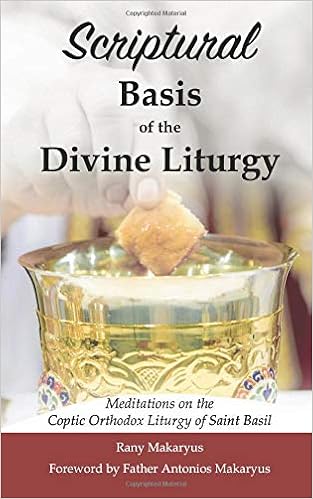
Book Preview: "Scriptural Basis of the Divine Liturgy" by Rany Makaryus


“The Scriptural Basis of the Divine Liturgy: Meditations on the Coptic Orthodox Liturgy of Saint Basil”
By Rany Makaryus
Price: £6.95  (Amazon UK)
ISBN: 1732891818

Today’s blog post will be slightly different to the usual. Instead of reviewing a book, we have the blessing of hearing from the author. Rany Makaryus’ book “The Scriptural Basis of the Divine Liturgy” is a wonderful introductory text to liturgical studies, exploring the scriptural links between the Liturgical prayers of the Coptic Orthodox Church and Scripture, as well as the origins of our Liturgical practice found therein.

So here is what Rany had to say:

“Do you remember the last time you focused on what was being recited in church before taking communion? It is very hard to focus on that. We always have so much on our minds as we stand there stressed out about work, conflicts with others, problems we are facing, and pending tasks we need to complete. Besides the stress, any little thing happening around us so easily distracts us¾just a small alert from our phone can send our minds off in many different directions. Worse is that it seems we have become rather immune to the many prayers that are recited on a weekly basis.

Growing up going to church on a weekly basis and being the smart aleck kid that I was, I liked to ask annoying questions such as, “If Jesus said that we should not use vain repetitions in our prayers, then why do we repeat prayers so many times during the liturgy?” Similarly, we might ask why the prayers in church are so long and drawn out. This might be the case in many different churches, but it is particularly true about the Coptic Orthodox Church. If you've ever been to one of our liturgies, you will realize just how long this could take. The shortest I’ve ever seen is at least 2 hours from when the service begins to when we heard the words “Go in peace.” Much happens in that time, and if we really care to know the answers to these questions, we should diligently try to understand what is being said and done.

The Coptic Orthodox Church presents us with many rich traditions and prayers that are meant to keep us rooted in the true faith.  In fact, as much as the liturgy is meant to prepare us for receiving Holy Communion, it is also a way for us to learn about our faith. There is so much that a believer can learn about Christianity simply by attending and paying attention during the liturgical prayers on a weekly basis.

When I started to dig deep into understanding why there are so many prayers, why they are all so important in preparation for receiving this sacrament, and how they were all put together in the form that we now have, it became very clear that these prayers have one main source, and that is the Holy Bible. I was most intrigued by the words of Saint Paul to the church in Corinth about their church gatherings saying, “For I received from the Lord that which I also delivered to you...” (1 Cor 11:23). This phrase indicates that this tradition of breaking the bread and sharing in communion with one another¾receiving the Body and Blood of Christ¾was instituted by Christ Himself. We can further extrapolate from this that this tradition was preserved by the church and passed down to us through the past 2 millennia. Further evidence of this is that different churches throughout the world, many of which have not maintained much communications for centuries, currently have very similar phrases used in their prayers.

How is it that these prayers can be preserved, not only through time, but also throughout many different cultures and traditions around the world? The reality is that this is mainly because these prayers have their roots in the scriptures that we all hold so dear to our faith. This was the principle inspiration for me as I put together my findings, leading to writing the book Scriptural Basis of the Divine Liturgy: Meditations on the Coptic Orthodox Liturgy of Saint Basil. Though it might be hard to focus on the prayers during the liturgy, if we really want to take our faith seriously, we should strive to understand the meaning behind these prayers that we hear on a weekly basis. Hopefully, with this new year, we can take a renewed focus on the liturgy and the depth of meaning we gain from it. “

Scriptural Basis of the Divine Liturgy is available now on Amazon UK:


For kindle version:

Saturday, 7 April 2018

Contemplation the Pascha Hymn “Thine is the Power” by HH Pope Shenouda III


In the name of the Father, the Son and the Holy Spirit, One God. Amen.

Today, I would like to talk to you about the important subject of the Passion Week. Passion Week is the holiest week of the year. And it’s good that we talk about it right now (before the start of Passion Week), so we can have an opportunity to enjoy this week spiritually. In this week, the church focuses completely on the suffering of Christ.

It does not become concerned with any other subject, but the suffering of Christ. It does not desire to think about any other matter.

Even the Psalms, it does not pray. Because some of the Psalms are about the Lord’s birth, Resurrection, Ascension and His Second Coming, and the church wants to focus solemnly on His sufferings. All the readings of the church are about the sufferings of Christ. This subject circulates in the church’s mind the entire week. In its hymns and appearance which is clothed in darkness. The front chorus is empty and the people remember that they are out of the camp.
All this, gives the idea that our minds shouldn’t wander away from the sufferings of Christ. You might have read or heard a lot about Passion Week, but I would like to talk to you about only one point: the prayer that the church has chosen to pray during the entire Passion Week. She has stopped the Psalms.

It turns out to be that the only thing the church prays is the praise that says, “Thok te ti-gowm nem pi o-ou nem pi esmo nem pi amahi sha eneh, amen… etc…” It means, “Thine is the power, the glory, the blessings and the majesty forever, amen…” We say these words to Christ the entire time. What does this mean?

We walk, step by step, following Christ and in every step we say in His ears, “Thine is the power, the glory, the blessings and the majesty forever, amen…” Christ goes to Jerusalem on Palm Sunday, the people welcome Him as a king, and we rejoice in the kingdom of Christ, saying to Him, “Thine is the power, the glory, the blessings and the majesty forever, amen…” And the chief priests and elders were displeased at the horde surrounding Christ, so they start to think of His death. And while they are thinking of His death, we are behind Him saying, “Thine is the power, the glory, the blessings and the majesty forever, amen…” After that, Christ stays a while at Bethany and we are behind Him with these same words.

Judas deals with the chief priests about His deliverance and we say to Him, the entire week, “Thine is the power, the glory, the blessings and the majesty forever, amen…” Christ is arrested and taken to be tried and we stand with Him in court and say to Him, while He is being tried in front of Pontius Pilate, Herod, Annas and Caiaphas the high priest, “Thine is the power, the glory, the blessings and the majesty forever, amen…” Christ is insulted, mocked, jeered and crucified and we stand under the cross and repeat the same hymn, “Thine is the power, the glory, the blessings and the majesty forever, amen…” Throughout all the sufferings that Christ bears, the nails hammered in His hands and feet, we say, “Thine is the power, the glory, the blessings and the majesty forever, amen…” During the entire time, we are not occupied with anything else. So what is the meaning of this prayer and how can we benefit from it? This is what we are going to discuss.

What are behind “Thine is the power and the glory”? We want to fully understand it. In this week, my brothers and sisters, the last development occurred in the strange struggle between Christ and the Jews. In respect to suffering, Passion Week is not the only painful week in the life of Christ. His entire life on earth was full of suffering. It was written about Him that He is a man of suffering and will experience sorrow.

A life full of pain, not just a week. But, this week, it has reached its limit. It is a struggle between light and darkness. In the beginning, the darkness hated and rejected the light. People liked the darkness more than the light because their deeds were evil. Then it developed that the darkness tried to destroy the light. It evolved to the point that the darkness accused the light of the being the darkness and that it was the light. It is a struggle between the light and darkness. This struggled was evident during the service of Christ. And it is strange that, during this struggle, Christ was not in resistance. “Like a lamb that is led to the slaughter, and like a sheep that before its sheerer is dumb; He was oppressed, and he was afflicted, yet he opened not his mouth” (Isaiah 53:7).

This is Passion Week! Christ said to them that this is your hour and the authority of darkness. Christ was given complete authority in heaven and on the earth, but He did not use His authority against the reign of darkness. He left the darkness to take its toll and violently work what it wants. Without defense. Without resistance. Without standing against it, while He was able to. He strangely let it go. As an obedient lamb even to the slaughter. And we look at Christ while He is being led to the slaughter. And we sing in His ears this hymn, “Thine is the power, the glory, the blessings and the majesty forever, amen…” Your submission to the works of evil causes you harm, anguish, insult, crucifixion and death.

This does not prevent you from being strong, praised, blessed and beloved forever and ever, amen. We know who You are – the Holy God. Christ submitted to the works of the darkness. Just like He gave Satan the freedom to tempt Him as he wishes, He gave the freedom to sinful mankind to torture Him as they wish. Even for Judas, “Jesus said to him, ‘What you are going to do, do quickly’” (John 13:27). Do whatever you want. It might appear before the people that He was weak. But if He was, it was not ordered of Him.

In His hands was all the power, and we know that. And we sing to Him and say “Thine is the power, the glory, the blessings and the majesty forever, amen…”

Thine is the Power

When Christ was insulted in Passion Week, we say to Him, “God, we know You, You’re not a stranger to us. These people think You were weak, and that You fell in their hands. Never! We remember all Your incredible power. We remember that You have power in miracles. You have power over the diseases that You healed. Power over the devils that You cast out. And power over nature. You are He who walked on the water and calmed the storm and waves of the sea. You broke most of the natural laws. We know that You have the power and are capable.”

Power of Creation

Before this also, You had the power. The power of creation. You created a new substance in the miracle of the five loaves and two fishes. And created a new substance when You changed the water to wine. Water consists of oxygen and hydrogen, while wine contains alcohol and grape juice. Where did all this come from? A new substance was created. In the miracle of the five loaves and the two fishes a new substance was created.

In healing the eyes of the born blind, a new substance was created. You have the power of creation. Not just in these days, but from the beginning, You created all things. “All things were made by Him; and without Him was not anything made that was made” (John 1:3). We know who You are. You were from the beginning and You created everything. You created the people that crucified You, the hand that slapped You, and the tongue that insulted You. All things were made through You. In Your hand is the key to life and death. You are able to do anything, but You don’t wish to. Thy will be done. We know that You have the power.

Power in Holiness

We also know that You have the power in holiness. You are the only one who defeated Satan. “For she (sin) hath cast down many wounded: yea, many strong men have been slain by her” (Proverbs 7:26). You were the only one left standing, because You have the power. You are stronger than everybody, for “all have turned aside: together they have become corrupted. There is none who does good, not even one,” (Psalm 14:3) and need the glory of God. Satan was able to trick them all, but You are the only strong one who bruised the head of the serpent.

Power of Endurance

We know more than this, that You have the power of endurance. Notice that Christ was strong in His crucifixion. Strong because He bore the accusations of the wicked even though He had the power in His hands to wipe them out. Who is able to endure like the Christ? Truly, power is in endurance. There are people who are quickly shaken, angered and weakened, but Christ was strong. There are people who can’t stand one word. Their blood boils, their nerves are tense, their personality is shaken and they want to get revenge. But, Christ was strong in endurance.

He endured His servants to slap Him on the face, spit on Him and insult Him. Who of us is able to endure this? The person who’s able to is truly strong. The Bible says, I ask of you “that are strong ought to bear the infirmities of the weak” (Romans 15:1). But, who of us is able to bear? Not only this, but to bear all of this from his servants, slaves and his own creation. Can a manager or a president of a company bear that one of his employees or janitors swear at him or say something rude in front of him? To bear that one slaps him? Or to spit in his face? Who is able to bear all this?

There is no doubt that Christ was strong in endurance. His endurance was based on the power of His love. Because the person who loves is able to bear and endure. He who doesn’t love isn’t able to endure. Christ was strong in endurance. He didn’t just bear the wicked and the accusations, He also forgave them. He didn’t just forgive them, but interceded, prayed and defended them in front of the Father. He said, “Father, forgive them, for they know not what they do” (Luke 23:34).

A New Measure of Power

Christ gave us, in His crucifixion, a new measure of power. Before, a strong man was able to insult, conquer and destroy another. But, Christ gave us a new example: a strong person is he who is able to tolerate others. Strength is not in shaking and stumbling others. The true power is in being able to love, gain and save others. Peter, the disciple, didn’t understand the power in Christ. He thought that crucifixion is a sign of weakness just like many people today.

And they ask, “how can Christ be crucified?” They think that crucifixion is weakness, but Christ was strong. We observe that Christ reached the pinnacle of His power when He was hanging on the cross! The highest level of love. The highest level of giving. The highest level of endurance. No one has greater love than this: to lay down His life for His friends (John 15:13). Peter didn’t understand this. That is why, when Christ said He was going to be crucified, he said “you can’t do that, O Lord!” Why did he say that? Because he didn’t understand the meaning of power. He thought that power was that Christ be a king and people worship, bow and kneel to Him.

Peter didn’t think that power was that Christ shed his blood for us. Peter didn’t understand power in another situation; when Christ was being arrested, Peter drew his sword and cut off the ear of the servant. He thought that this was power and bravery. Christ told him no, concerning killing the servant, that’s easy, it’s easy to kill all these people, but power isn’t that we kill them, but bear them. That is the true power. Just like John and James the sons of Zebedee, they thought that power was that fire come down and burn the city of the Samaritans that shut it’s doors in the face of Christ.

Christ told them that that isn’t power. The power is that I bear them, have patience on them and wait until I save them. That is the true power. He said, “you do not know what manner of spirit you are of. For the Son of Man did not come to destroy men’s lives but to save them” (Luke 9:55,56).

 Christ gave is a live, practical example of power. He didn’t explain in detail the meaning of power, but presented an example of it from a Christian point of view. Power that ascended accepted and bore the cross for the sake of others. But the person that’s shaken from one, small word is a weak person. That person can’t bear the injustice of the wicked and therefore becomes shaken quickly. When we stand in the presence of the cross, my brothers and sister, we don’t stand to weep over Christ like Mary Magdalene and the daughters of Jerusalem did or to mourn and greet Him.

We stand near the cross to glorify the cross and He who is crucified upon it and to sing to Him the lovely hymn, “Thine is the power, the glory, the blessings and the majesty forever, amen…”
We Boast in the Cross

Therefore, we boast in the cross. “But God forbid that I should boast except in the cross of our Lord Jesus Christ” (Galatians 6:14). If the cross was a sign of weakness, we wouldn’t boast in it! If the cross was a sign of weakness, we wouldn’t hang it in our churches, on top of our towers, around our necks, engraved it in our hands or took it as a theme in all our occasions.

To us, the cross is a sign of power. In it appears the power of love, self-sacrifice and endurance. Indeed, this is the true power. Many people said to Christ if you were the Son of God, or if you were powerful come down from the cross. If Christ had come down from the cross, humanity’s salvation would have been lost. He was never overcome by this false glory or the wrong meaning of power because He was strong. Expressions of glorification did not matter to Him.

Christ never thought of Himself, but of us. He didn’t care about saving Himself, but about our salvation.
Contemplation the Pascha Hymn “Thine is the Power” by HH Pope Shenouda III

Sunday, 19 February 2017

Book Review: Coptic Christianity in Ottoman Egypt By Febe Armanios


Coptic Christianity in Ottoman Egypt
By Febe Armanios
ISBN: 0190247223
Price: £17.27
Febe Armanios’ book is one that I had been looking forward to reading for (literally) years. Whilst writing my Mth Thesis on the development of the Coptic Papal Election system one of the great difficulties was a lack of academic writing on the Coptic community during the Ottoman Era, and this text fills in the gap nicely, using sources from both Ottoman and Coptic records to give a broader understanding of the historical period and the community relations therein.

Armanios’ writing takes a thematic approach to the topic, looking at specific themes and historical instances during the Ottoman Era in Egypt in order to gain an insight into the place of the Coptic Church in society as well as the allowances and practices of the community in the Ottoman yoke. The text starts with a look at the sources available to us to do this, and raising the issue of lack of available sources to academics. It goes on to look at martyrdom stories and their impact on the community, pilgrimage and the development of rights and finally to cover the use of sermons to define Coptic identity during conflicts with missionaries from the Catholic and Protestant communities.

The structure of the text and its great insight into a very loosely explored period in Coptic history allows this book to demonstrate some great and original research into themes which have not been looked at. As well as this, Armanios’ approach to the topic and the readability through which she expresses her research allows the reader to access a vast historical landscape in an easy manner. This readability and originality makes Armanios’ book a great read and certainly one to be recommended to anyone with an interest in Coptic history or general Ottoman studies.

As for any weaknesses, the main one is one which Armanios herself addresses in the book. In the introduction she states that due to prejudices with regards to the period and a general lack of scholarship as to Coptic communal history the text can only give a broad overview of the period without delving into any of the subjects in further detail. Therefore to any specialist reader looking into a certain aspect of Coptic history or Ottoman history in Egypt it can seem too loose in areas, though this is not the fault of the writer but simply a symptom of a lack of academic resources available.

Overall, I thoroughly enjoyed the book. As mentioned, it is readable and original in its scholarship which allows it to be a text with a lot to offer the reader. I would recommend it to anyone looking to fill in this much misjudged gap in Coptic Historical studies and anyone with an interest in the development of modern Coptic society generally.

Making Lent Great Again: Some thoughts on Lenten Preparation


With Great Lent approaching I promised myself that I would write a few points on the subject both to prepare myself and to share with any others needing a boost in their own preparation. Whilst pondering this on the way home I decided to specifically look at how to make the Great Lent meaningful especially for those who take it with a touch of “oh, here comes the fast again…” and thus the title “Making Lent Great Again.”

Starting with the basics, what exactly is the Great Lent and why do we partake in it? Lent is the forty-eight-day period leading up to Feast of the Resurrection. The practice of fasting in preparation for this event is dated back to the Apostolic Era, where we see the likes of St Irenaeus of Lyon, St Athanasius the Apostolic and multiple other fathers of the Church write on the importance of holding a period of fasting to prepare ourselves spiritually for this event. By fasting we do not just speak of the abstinence from rich food, sexual contact and other temptations but the reduction of distractions from our spiritual lives to make way for acts and meditations which will prepare us for the remembering of Christ’s resurrection.

This distinction between the Orthodox practice of fasting and simply abstaining from foods is vital, it reminds us that the Great Lent is a journey in which we take take our full selves out of the busy modern life to seek the fullness of God once more. as St John Cassian reminds us that bodily fasting is useless unless accompanied by, “contrition of heart, intense prayer to God, frequent meditation on the scriptures, toil and manual labour.” Through these actions, we are given guidance as to how to remain focused on God and not on worldly distractions.
So what is the purpose of Lent? I have mentioned the historical reason for it existing and how it is a preparation for the Feast of the Resurrection but the real purpose of the period needs more examination. Fr Tadros Malaty explains how the period has a two-fold purpose for the Orthodox believer; to prepare us to fully experience the joy of the resurrection and to prepare us with practical repentance and teaching so that we may enter the feast with complete contrition of heart and understanding of the implications of the event. As St Paul teaches in his Epistle to the Romans, “then we are heirs—heirs of God and co-heirs with Christ, if indeed we share in his sufferings in order that we may also share in his glory.
With this knowledge, We can now look at how to prepare ourselves for the fast. Firstly, preparing for Lent does not mean stacking our fridges with as many ‘meat substitutes’ as possible, as this is simply a way of trying to cheat at the fast. If your idea of Lent is “Today I ate Vege-Sausage and margarine mash instead of Sausage and mash, yay me,” then you have not begun to fast. Preparation for the fast is a matter of spiritual preparation for the fast as opposed to arming yourself with ways to avoid it having any impact at all. If you must try out new recipes or adapt then so be it, just remember that fasting is not about showing off your extravagant new cooking skills but placing things aside to focus on God.
Practically speaking a good way to start the journey of the Great Lent is to ensure that you lighten your timetable, this is difficult in a world where many of us work 12 hour days. Do this by working out what you should really be putting aside for your prayers in the first place. Whether this is that excess social engagement, that TV binging evening or the gaming that you enjoy on a far too regular basis. A practical development of a prayer rule is a good way to pick up a good habit. Ensure that you give yourself that hour or so a day with family to pray in the morning and evening, as well as other times if you can. Also ensure that you have time to read Scripture to achieve this sense of immersion in the lessons being passed on to us through this practice. It is appreciated that this is not always going to be smoothly, but as HH Pope Shenouda III reminds us “we must repair the results of our sins as much as we can,” we all miss the mark, it is how we respond and in not giving up that we grow. As lent passes and your praying of the hours and reading of Scripture becomes more of a natural part of your life you will feel this impact, as is the aim of the extended fasting period. This will also strengthen your spiritual life on the daily basis after the fast.
As well as this, remember that lent is a time of giving and for rejecting the material distractions of the world to be reminded of our priorities. Many have suggested practical ways of doing this, such as giving any excess money you would have used on the things you have on charitable endeavours or by giving up things to charity during this period such as old clothes. There are also many ways in which you can be more charitable in your nature. As lent is a time of prayer you can work to ensure that you pray for others or spend your excess time assisting those who need it. Charity is not always a matter of giving physically or financially, the greatest and sometimes most difficult of chartable acts that are carried out are those that cost nothing, as they demand us to give emotionally.
Finally, lent is a time for repentance. As mentioned previously, lent is the time in which we aim to prepare ourselves to fully experience the joy of the resurrection through practical repentance. We have already looked at three ways to do this; fasting, prayer and charity. Through our prayers and out focus on rejection of those things which have distracted us from God and our service of him, we are enabled to see our sins clearly. In working towards casting these things aside we can develop a better understanding of our own repentance. The great battle of repentance in the fast is something that Fr Matta El-Meskeen described as working towards, “an acceptance of the destruction of self,” through rejection of one’s own wants and desires to focus on God. Lent, with its emphasis on selflessness, gives us an edge in this battle and allows for the practical application of these various Lenten practices of fasting, prayer and charity to see one’s failings and develop ways to counter them as part of this journey in preparation to announce the resurrection of our Lord in full joy.
On this note, I will end this short piece and I hope that it has given you some ideas as to how you can ‘Make Lent Great Again’. I wish you all a blessed Lenten period, asking for whoever reads this to pray for me and my own efforts. I hope that this has been useful in some manner.
Dcn Daniel


Wednesday, 15 June 2016

Book Review: Christianity in the Land of the Pharaohs by Jill Kamil


Christianity in the Land of the Pharaohs
By Jill Kamil
ISBN:
RRP: £34.99

Jill Kamil’s “Christianity in the land of the Land of the Pharaohs is a book I picked up last year on a visit to the AUC in Cairo. Having finally gotten the chance to read it through, I found it a very interesting book and a change from the usual texts on Coptology and Egyptian History due to its change in focus from the Church and its teachings to the people of Egypt themselves. As a text on the history of the Coptic Orthodox Church it avoids any of the traditional trappings of selling itself as an apologetic for the Church and looks at the links between Egyptian Culture and the Church’s development. This is both quite refreshing and somewhat frustrating for the reader.

The book is structured in a way that gives the history from the visit of the Holy Family to the modern times. The Chapters consist on various historical instances, such as the rise of monasticism, the legalisation of Christianity, the Chalcedonian Council, Roman Persecution and the rise of Islam. These all allow for the book to flow in a way that creates a clear narrative, however this is sometimes confused by tangents from the author which can at times disjoint the flow of the text. The book ends with a look into the future of the text, in which the author praises the conversation of Icons in monasteries and the revival of this practice, demonstrating the preservation of many of the aspects covered in the book today.

In a way, this book is a breath of fresh air, since it takes a very novel approach to the history of the church. It does this by avoiding dwelling on any of the traditional Theological aspects which many would fawn over it looks at the Church as the Christian people of Egypt. In the same way, it has a brilliant analysis of Egyptian monasticism as a phenomenon within the cultural scape of Egypt. This allows the book to sell itself as a purely historical endeavour, making this clear from the start when it makes a historical link between the worship of Isis in the Middle-Kingdom and the strong veneration of the Virgin Mary. This is a rare and often side-lined focus, though in the case of this text it marks as a marker for the way in which the book will flow into a demonstration of the development of an ‘Egyptian Style’ of Christianity. 

In the same way, the nationalistic tendencies of the text are also its downfall. Rather than the book being a history of the development of Orthodox Christianity in Egypt it retains far too prominent a focus on the Egyptian cultural element as opposed to the Church itself. This can often be a frustration to the reader, as it forces them to endure a 5 page link to pagan practices in pre-Christian Egypt followed by an explanation of how the Christian idea is superimposed onto this. I feel that, when reading from a Christian stance, it damages the book as a text on the history of the Church as it almost implies that the cultural element is more important than the Church itself.

So, would I recommend this book? Yes, to some extent. I would certainly recommend it to anyone interested in a cultural history of Egypt and understanding the influence of its ancient past on the development of Coptic Civilisation. In the same way, I would advise it to anyone interested in the development of Coptic culture and the Church as a ‘national church.’ On the other hand, I would not advise the book for someone looking into the development of the Church from an Orthodox perspective, though I feel that this is not what the book was designed for. Overall, a good and interesting Cultural history book, though not for someone seeking a text on the Church itself.