Tuesday, 19 January 2016

Book Review: ‘Encountering the Mystery: Understanding Orthodox Christianity Today’ By His All-Holiness Ecumenical Patriarch Bartholomew I of Constantinople.


‘Encountering the Mystery: Understanding Orthodox Christianity Today’
By His All-Holiness Ecumenical Patriarch Bartholomew I of Constantinople.
ISBN: 9780385518130
Price: £12.50 (Amazon UK)

People often say that a New Year requires a new perspective, new goal or new beginning to life. I do not prescribe to that idea in any formal way but it is always a blessing to have your eyes opened to a new approach or perspective on matters you have studied for years, especially when you realise that some complex explanations can in fact be so simple that you missed the core all along. This is pretty much the impact that this book has had, it has not drawn any significant new information for me but has demonstrated the simplicity and beauty of the Orthodox Faith in a way that other introductory texts never got close to.

The book, by HAH Bartholomew, is a brilliantly personalised introduction to the Orthodox Faith which covers many aspects of Orthodoxy alongside their importance and role in the modern world. The main aspects of the text cover the Topics of History, Iconology & Liturgy, Theology, Monasticism, Sacraments, Iconology, Freedom and Justice. The first five of these focus on major factors of the Orthodox faith and allowing the reader a basis in which to tackle the modern moral issues raised in the other four (as well as the epilogue.) This way it provides both an introduction to the faith and allows the reader to understand its relevance in addressing modern issues, giving a basis for developing the faith within the modern world. Though this focus on ‘Orthodox living’ means there is no deep coverage of such matters as Christology and other such aspects, I feel that this does not take away from the book as a whole with regards to its use as an introductory text.

Due to this structure, I find the book unique amongst introductory texts which, when speaking in terms of history and the modern world, usually tend to focus on the History of the Church followed by some small chapter on the Church today rather than starting with a few pages on History and then expressing Orthodox approaches to the modern world. This makes the book extremely readable as a personal account on these issues by H.A.H rather than a generic ‘This is where we come from and this is what we believe’ introduction to Orthodox Christianity.
This personal aspect is also one of the draws of the more doctrinal explanations of the book, with H.A.H ending many explanations of theological concepts with a short anecdote or personal note from his own life such as comments regarding his fondness of his personal chapel and liturgies in the smaller Churches in the Patriarchal Complex. This can allow the reader to develop a further appreciation for the beauty of the Orthodox Faith and the important impact of these key factors of the Faith on the life of the individual as opposed to simply having ideas explained to them. 

Though I have listed a number of strengths of the book, I would have to say that the simplicity of the writing is its biggest draw. As someone who has studied theology academically for over a dozen years and taught it for the past five, it is always an awkward moment to realise that the concept that you spent 20 minutes explaining to a group of 16 year olds only a few weeks ago can be outlined in the most beautiful language in less than a page. In this way, the book is accessible to people of all levels of understanding and makes a great introductory text for those with little grasp of technical language or little intention to study the more in depth points of theology. To put it simply, it is a book written from experience of living the faith which is a viewpoint missed by many in a world of bitesize Theology websites and podcasts. 

Alhough the book is a great introduction to living the Orthodox Faith, the one issue that I would raise is based on the book’s suggestions to some of the issues it raises, an example of this being in the Ecology section. H.A.H is commonly referred to as ‘The Green Patriarch’ for his admirable approach to environmentalism, though the book seems to play out his respect for the environment in a more idealistic way than other texts. This approach also enters into some of the other sections and though this provides some insight into the spiritual aspects of all areas of life it can seem overbearing when reading it from the position of the layman.

Overall I would certainly recommend the text to anyone beginning to take an interest in Orthodoxy, and it may well replace HE Metropolitan Kallistos’ text as my first choice for a number of new enquirers, however the text also provides a refreshing approach to living the Faith for other Orthodox readers and is certainly a healthy addition to my bookshelf.

Saturday, 2 January 2016

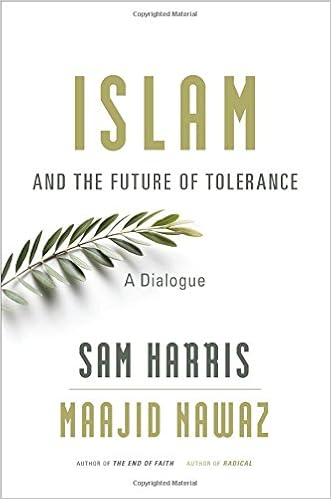
Book Review: "Islam and the Future of Tolerance" by Sam Harris and Maajid Nawaz


"Islam and the Future of Tolerance" by Sam Harris and Maajid Nawaz
Harvard University press (2015)
ISBN: 9780674088702
Price: £9.77 (Amazon UK)
I picked up this book after watching a number of debates in this matter by both writers. With a keen interest in both current affairs and Islamic Theology and Exegesis, I decided to give the book a read, not having any real presumptions as to the depth of content. On this matter, I was presently surprised, with the book portraying a fair and balanced discussion of the question of the links between exegesis and faith, as well as the social issues.
The book itself is a short read, at 128 pages, and can be easily read over a few days. It is formatted as a dialogue between the two thinkers, with Sam Harris often portraying the student and stating the issues, with Maajid Nawaz filling in the  details from the Islamic perspective, followed up by Sam Harris' response of 'I agree but..." to move the conversation on. In some areas it is split into sections, however this is only where there is a significant shift in the conversation.
The topics discussed in the book mainly focus on the question of how to tackle Islamic extremism and its source. it starts this by looking at the problem of identifying the exact issue, doing this by clarifying the names of the different forms of extremism faced (Specifically the difference between types of Islamism and Jihadism) and illustrating the difficulties caused by misattributing thinkers and  events to a different school of thought. The discussion then moves on the failure to tackle the problem in the west and how this is exacerbated by the ‘regressive left’ and rise of the far right across Europe. This finishes on the more controversial question on whether this strain of thought is inherent in Islam, to which there is a fascinating discussion of schools of Exegesis and the variety of thought in medieval Islam, along with some harsh condemnations of the illusory ‘Islamic Utopia’ sold to us by many modern popular historians.
Some of the key points I enjoyed about the book were the honesty, the candid nature of the discussion and the fact that it opened up a topic for discussion which is shied away from by many for fear of being branded as a bigot or islamophobe. The early discussion on the issue of the ‘Liberal Betrayal’ opened the book up for this honest discussion of the topic in a way which is rarely seen, something which is not possible in many academic texts, which demonstrates an advantage of the format and the open-mindedness of Nawaz with regards to his willingness to critique the ideas rather than attack a strawman. As well as this, the discussion of the exegetical schools and Nawaz’s readable yet sufficiently academic explanations of such concepts as Taqqiyah allowed for the reader not to be drawn into any of the traditional polemical ideas which we see on the side for the far right. 

In the same way, Sam Harris’ role as the skeptic worked well in the text, an example of this being his assault on the mythical ‘Utopia’ view of the Ottoman Empire. This position allowed for the more balanced approach, instead of the book becoming the ‘Maajid Nawaz show,’ with some very frank statements on attempts to put the concept islamic extremism down to purely political grievance allowing the book to tackle the issue of islamic Extremism straight and in a way which maintains the interest of the readers, many of whom would have picked this book up with the intention of seeking a fair discussion of the question of the link between Islam and Extremism.

The format, as well as being what stabilizes the book, is also the cause of my one criticism. Due to the conversational format of the text it is prone to the occasional glossed over and unclarified statement, in some cases leading to factual error. One of these points which caught my attention was Nawaz’s claim comment on the Council of Nicaea being the point at which Rome accepted Christianity. This point is clearly a factual error, but due to the book being in a dialogue, the point is one simply glanced over as an example of ‘Dominant Doctrines’ and their power rather than clarified or linked to another point. The happens on a few occasions in the book and at times can hit the reader with a reminder that the book is not a piece on religious thought specifically but a dialogue between two academics discussing a socio-political issue developing in the realm of religion. 

So would I recommend the book? Yes. It is a very good short read into this complex and often misappropriated topic of Islam and Extremism, and sufficiently covers and clarifies the more complex points of it to make the reader satisfied that the text delivers on its promise of a reasonable and fair dialogue which does not avoid controversy or sell itself as a polemic. Overall, an excellent starting point for some truthful and honest discussion on a matter which is avoided far too often.

Sunday, 16 August 2015

On Theological Discussion - A Reflective Commentary on St Gregory the Theologian’s 27th Oration (Part 2)


On Theological Discussion - A Reflective Commentary on St Gregory the Theologian’s 27th Oration (Part 2)
By Deacon Daniel Malyon
 (Part 1 of this commentary is found HERE)
 
Following the explanation of why external influences should be removed from our discourse in the previous section, St Gregory examines the inner life of the Theologian and the internal factors that should be considered before we are ready to engage in such discourse in order that we may “Smooth the Theologian within us, like a statue, into beauty,” the first of which is the examination of our motive in the discussion. Motive in an important examination as any discussion for the sake of self-gain or malice would profane the words from our tongue and present “greater violence than is pleasing to The Word.” Therefore, before we see ourselves as worthy to discuss the faith St Gregory suggests in this that we ask of ourselves “Do we commend hospitality? Do we admire brotherly love, wifely affection, virginity, feeding the poor, singing Psalms, night-time vigils, penitence?” along with many other qualities such as fasting, prayer, self-examination, mastery over passions, and a good temper. This is a reminder that we may speak out of pride or claim a superiority when it is a clear fact that none of us are worthy of God’s mercy or to speak a word in his name. This message is emphasized in the interaction that follows through the use of the Dialectical (conversational) style during the eighth Section.
Following this comes the analysis of motive, on the presumption that the Theologian has achieved a moral and spiritual life which has allowed them to have “looked upon things which cannot be seen” and become like “A second Elijah” or “A second Moses, judged worthy to see God.” This begins with a quick witted question that if you have attained this level of Holiness, why you would prepare people into a state of Holiness if your only intention is to use them as a “council of ignorant intellectuals,” with the purpose of using them to entangle others in a way that would “Stir a Wasps nest against the faith,” by which he refers to the idea of teaching others to argue with others of the faith to seek a sense of self-righteousness. Of course this is again not referring to all Theological discussion but this idea of “Itchy tongues” seeking to argue for the purpose of argument, regardless of their own personal level of Holiness as though they “cannot hold back words that, once conceived, must be delivered.”
This leads us to his last point on what points can be discussed. St Gregory here makes it clear that the main target for Christian apologetics at his time was the Hellenic Philosophers, which writers such as Theophilus of Alexandria and others in the century prior wrote great apologetic pieces. St Gregory lists the likes of Pythagoras’ Orphism, Plato’s Cycle of Souls or Epicurus’ Atheism as common Christian targets of his time. He follows this with the advice to “Attack the void” in such discussions, the void being “the mumbo-jumbo of gods and sacrifices, idols, demons beneficent or malignant, of soothsaying, summoning of the gods or the spirits of the dead and of the influences of the stars.”
Though this may seem to be a way of saying not to discuss Christianity, he also provides topics within Christianity which are ‘fit’ for discussion such as “the Universe- Or universes, about matter the soul, about Natures (Good and Evil), rewards and punishments or about the sufferings of Christ.” St Gregory gives his reasons for these being allowable for discussion as the fact that with these “to hit the mark is not useless, to miss it is not dangerous.” Meaning that these are not issues which at the time there were specific Church doctrines on and therefore their speculation is acceptable in discussion. This again, when combined with Gregory’s understanding of what makes an acceptable time to discuss these matters shows that St Gregory had no major problem with discussion of such matters but the impact on the faith and the person’s spiritual life.
Regardless of this, St Gregory does hold a view of one topic which is above all discussion, this is God. He explains this by saying “Of God himself the knowledge we shall have in this life will be little, though soon after it will perhaps be more perfect, in the same Jesus Christ our Lord, to whom be glory for ever and ever.” Here we again see this view that discussion of God and his Nature is not up for debate, as these are aspects which are unknowable in essence, have great impact and can lead to the development of heretical and Profane Doctrines.
So what can we learn from this text in our own spiritual lives, especially with regards to those who indulge in theological discussion and debate on modern media platforms. From St Gregory’s Oration we can see that there are various rules and examinations which we should concern ourselves with before we engage in any form of discussion on the faith which concern both the external and internal context of the discussion.
In terms of the outer contexts, St Gregory sees it as important that we must ask ourselves whether the discussion is in the correct settling and to an audience to whom the topic is proper and beneficial. This does not mean that we judge this by our own personal standard but that we respect the setting. Believing that the man next to me on a bus needs to know about the unknowability of God does not make the discussion proper, as it would not benefit him or make the timing or place of the discussion proper to the Glory of God. I do not know what his views or level of knowledge are, whether he has any concept of God or even whether he has any interest, so it is not right to engage him in such a discussion especially if it will only give a fraction of understanding. Therefore one should ask where and when they should engage in such discussions before beginning them, so as not to present the faith as any less than it is.
Secondly comes the more complex inner examination. One should ask whether they are really fit to discuss the faith and their own motive in the discussion. In questioning our fitness to discuss the mystery of the faith  we must ask whether our own spiritual life is at a point where our presentation of the faith can do it justice as well as our knowledge of the subject. This is because wisdom in the mystery of the faith is not as with any academic science but comes from engagement in the Doxa and Praxis of the faith which are inseparable by their nature. If I were to approach such topics without true understanding of them I would end up presenting them as another idea in the maelstrom of ideas and estranged from the praxis of the Church, and if I have no understanding I would be unable to express them. This is a balance which we must all strive for so as not to misrepresent the faith to those who wish to find God.
The second of these inner examinations comes from motive, and is one which I see of as vitally lacking today amongst those who sell themselves as Theologians. Before engaging in discussion of matters of faith we must ask the simple question of why? Are we starting a discussion to try and ‘win’? Are we trying to gain social respect for our words or are we angered by someone and wish to state an opposing view. If so, we must refrain as we would risk speaking of the word with “greater violence than is pleasing to The Word.” A correct motive in this speech is to give a fair presentation of the faith through experience and wisdom, if we cannot provide this we have no place to speak as we are not demonstrating in ourselves a prayerful member of the Church but just another hollow man of words and an ‘itchy tongue’ rather than a pure heart and mind.
From these we grasp the message of the Oration which is one of self-examination as to whether we can ever speak in a way that does justice to the faith that we claim to represent. If we are not able to do so then we must ask why we believe we can benefit the Church in attempting to speak on her behalf. If we speak for our own gain we are deceiving and if we speak in ignorance we do damage,. Therefore, in all cases we must ask ‘why speak at all?”