Showing posts with label greek. Show all posts

Tuesday, 19 January 2016

Book Review: ‘Encountering the Mystery: Understanding Orthodox Christianity Today’ By His All-Holiness Ecumenical Patriarch Bartholomew I of Constantinople.


‘Encountering the Mystery: Understanding Orthodox Christianity Today’
By His All-Holiness Ecumenical Patriarch Bartholomew I of Constantinople.
ISBN: 9780385518130
Price: £12.50 (Amazon UK)

People often say that a New Year requires a new perspective, new goal or new beginning to life. I do not prescribe to that idea in any formal way but it is always a blessing to have your eyes opened to a new approach or perspective on matters you have studied for years, especially when you realise that some complex explanations can in fact be so simple that you missed the core all along. This is pretty much the impact that this book has had, it has not drawn any significant new information for me but has demonstrated the simplicity and beauty of the Orthodox Faith in a way that other introductory texts never got close to.

The book, by HAH Bartholomew, is a brilliantly personalised introduction to the Orthodox Faith which covers many aspects of Orthodoxy alongside their importance and role in the modern world. The main aspects of the text cover the Topics of History, Iconology & Liturgy, Theology, Monasticism, Sacraments, Iconology, Freedom and Justice. The first five of these focus on major factors of the Orthodox faith and allowing the reader a basis in which to tackle the modern moral issues raised in the other four (as well as the epilogue.) This way it provides both an introduction to the faith and allows the reader to understand its relevance in addressing modern issues, giving a basis for developing the faith within the modern world. Though this focus on ‘Orthodox living’ means there is no deep coverage of such matters as Christology and other such aspects, I feel that this does not take away from the book as a whole with regards to its use as an introductory text.

Due to this structure, I find the book unique amongst introductory texts which, when speaking in terms of history and the modern world, usually tend to focus on the History of the Church followed by some small chapter on the Church today rather than starting with a few pages on History and then expressing Orthodox approaches to the modern world. This makes the book extremely readable as a personal account on these issues by H.A.H rather than a generic ‘This is where we come from and this is what we believe’ introduction to Orthodox Christianity.
This personal aspect is also one of the draws of the more doctrinal explanations of the book, with H.A.H ending many explanations of theological concepts with a short anecdote or personal note from his own life such as comments regarding his fondness of his personal chapel and liturgies in the smaller Churches in the Patriarchal Complex. This can allow the reader to develop a further appreciation for the beauty of the Orthodox Faith and the important impact of these key factors of the Faith on the life of the individual as opposed to simply having ideas explained to them. 

Though I have listed a number of strengths of the book, I would have to say that the simplicity of the writing is its biggest draw. As someone who has studied theology academically for over a dozen years and taught it for the past five, it is always an awkward moment to realise that the concept that you spent 20 minutes explaining to a group of 16 year olds only a few weeks ago can be outlined in the most beautiful language in less than a page. In this way, the book is accessible to people of all levels of understanding and makes a great introductory text for those with little grasp of technical language or little intention to study the more in depth points of theology. To put it simply, it is a book written from experience of living the faith which is a viewpoint missed by many in a world of bitesize Theology websites and podcasts. 

Alhough the book is a great introduction to living the Orthodox Faith, the one issue that I would raise is based on the book’s suggestions to some of the issues it raises, an example of this being in the Ecology section. H.A.H is commonly referred to as ‘The Green Patriarch’ for his admirable approach to environmentalism, though the book seems to play out his respect for the environment in a more idealistic way than other texts. This approach also enters into some of the other sections and though this provides some insight into the spiritual aspects of all areas of life it can seem overbearing when reading it from the position of the layman.

Overall I would certainly recommend the text to anyone beginning to take an interest in Orthodoxy, and it may well replace HE Metropolitan Kallistos’ text as my first choice for a number of new enquirers, however the text also provides a refreshing approach to living the Faith for other Orthodox readers and is certainly a healthy addition to my bookshelf.

Monday, 4 May 2015

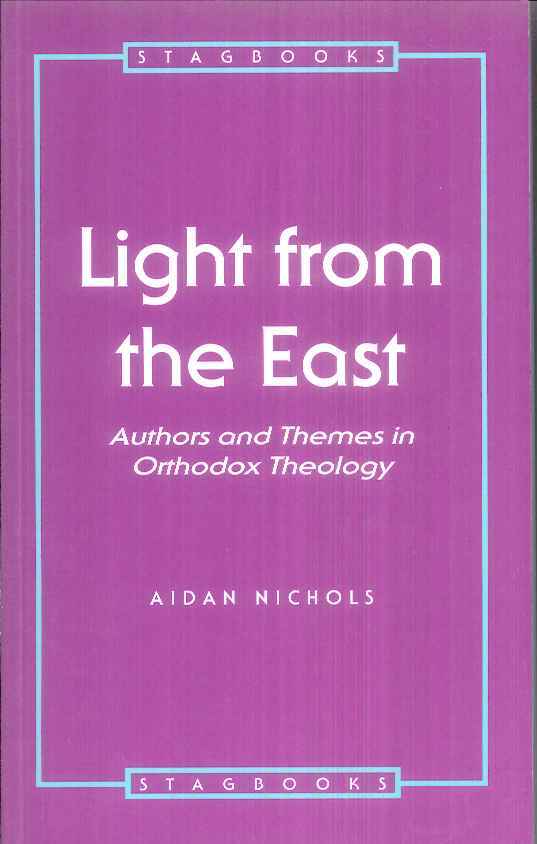
Book review: Light From the East By Aidan Nichols


Light From the East
By Aidan Nichols
Continuum Books (1995)
ISBN: 072205081X
Price: £34.99 (Amazon UK)

Review By Deacon Daniel Malyon (British Orthodox Church)

There are a number of books which track the development of Eastern Orthodox thought in the 20th Century, though usually these are focused on a singular concept or theme. In Light from the East, Aidan Nichols has removed this thematic element to allow for a broad overview of the major players in the 20th Century Orthodox Theological world and allowed for these themes and ideas to be explored in a wide-ranging collection of thinkers.

The text explores the key works and ideas from well-known modern Orthodox Theologians such as Vladimir Lossky, Sergei Bulgakov, Nicholas Afanasiev, Georges Florovsky amongst others. In each of these sections there is a short biographical passage, explanation of the context in which the thinker emerged, coverage of ideas and an evaluation of the key development with which the thinker is most associated. This makes the text somewhat unique as it is based organised in a fashion which emphasises the specific person and not their idea. This also allows for a deeper exploration of the development of these ideas throughout the life of the writer as opposed to simply addressing it is a simplistic form.

The book would be of some use for someone (such as myself) with some grasp of the seminal works of the thinkers covered but who wishes to get to grips with the development of Eastern Orthodox thought in the past century as a whole. This is because of the structure above all, which I have already praised for its focus on the context as opposed to simply the ideas. In this way the book demonstrates a positive growth in the level of ecumenical research being carried out by thinkers in the west and makes the text praiseworthy for that significant step in both an academic and ecclesiological sense. 

In the same way, this academic structuring of the book is a weakness, as the evaluation section seems to depend on decontextualizing the idea and dissecting it through means of a western approach. When looking at such ideas as the radical apophatic theology of Lossky, this approach seems to undermine the very essence of that apophatic thought by tackling it through means of analytic thought. In this way, the criticisms levelled by the author become irrelevant to an Orthodox reader who simply wishes to look into the developments from within his/her own tradition.

Overall, I would recommend this text to anyone who wishes to get to grips with the various and somewhat divergent schools of thought of Eastern Orthodox Theology in the 20th Century. It gives a great overview of the various thinkers involved as well as the way in which their ideas were formed, allowing for a broader explanation of these developments than many other texts would allow.


Wednesday, 4 September 2013

Structure and Synod in the Orthodox Tradition


General Structure

The Orthodox Church has no specific 'job titles' so to speak, though specific members of the Heirarchy will have specific titles according to their means. Here are some key examples and Explanations of terms.

Within the Eastern Orthodox Church there are 9 Patriarchs, with 6 Autocephalous Metropolitans who were granted Autocephaly over their various territories by the Patriarchates. Neither of these answer to a higher authority except for The Archbishop of Athens whose territories are partially under Constantinople.

There are six further Autonomous Archbishops/Metropolitans who have regional control over their territories, these were granted their Autonomy through one of the larger Churches and therefore cannot take the title of Patriarch as their head is appointed through another Patriarch.

(List Of Eastern Orthodox Heirarchs Here)

As well as this, within the Non-Chalcedonian Tradition there are 6 Oriental Orthodox Patriarchs/Catholicoi, with 4 Titular Patriarchs (and Catholicoi) holding Authority over specific areas but recognizing the Spiritual Authority of their Patriarch overall. The Oriental Orthodox community and Eastern Orthodox are not in communion, due to the Chalcedonian Schism of 451, though each retains its structure, with some cases of dual Patriarchs in the same place (Alexandria, Antioch, Istanbul/Constantinople, Jerusalem)

(List of Non-Chalcedonian Heirarchs Here)

Each Patriarch has authority over his Patriarchate, with no interference of others, though to make major decisions he would need the support of his Synod (Bishops in his Juristiction) and in many cases is expected to have support from the other Patriarchs, which is why the Orthodox Church does not have the changes in Doctrine in the way that other communities may.

Titles for heads of Jurisdictions
The head of a specific community will generally be called a Patriarch, Pope or Catholicos. 
Patriarch is the most common title for the leader of an Orthodox Community.
The term Pope originates in Egypt in the Patristic era and has been continued to be used by the Coptic Community rather than Patriarch. The Official Title of the Greek Orthodox Patriarch of Alexandria is also "Pope and Patriarch of Alexandria and all Africa" though he is commonly simply called Patriarch.
Catholicos means 'Of the Whole' and is used by the Georgian Church in the Eastern Tradition and Armenian and Malankara (Indian/Jacobite) Churches in the Oriental Traditions

Titles for Bishops
Within each Jurisdiction there are Bishops heading Dioceses or with an Administrative role. They will have Titles based upon their role and authority

Metropolitan Bishop/Archbishop was the highest Authority until the title Patriarch was created at Nicaea in 325. These Bishops can rank above or below Archbishops depending on the Tradition (Macedonia and Serbia hold Archbishops as higher, most others rank Archbishops lower). They have no specific power or direct authority over other Bishops, though have the right to oversee Synods and Councils due to their higher authority in the Church itself. 

Archbishop is the title for a Bishop of greater responsibility than other Bishops, He may not always hold a Diocese, as it may be a title for a administrative responsibility.

Bishop is the title given to the head of  Diocese. The title dates from Apostolic times and is present in the writings of St paul, as well as St ignarius the Apostolic, who stated that all must be done through the Bishop. a Bishop is traditionally a male monastic (Since the 6th Century) or Celibate Priest, who has a role over an administrative function or Diocese. until recent times, these were only Diocesan and could not be transferred between Dioceses (By the Nicene Canons they were seen as 'Married' to one) though in recent years in the Eastern Orthodox Church this has changed. A Bishop without a Diocese is called a 'Titular Bishop' in the Eastern Orthodox and 'General Bishop' in the Coptic Orthodox Church.

The Synod
The Synod is the group of meetings. Since Orthodoxy keeps its Conciliar Structure, they play a vital role in discussing issues regarding the jurisdiction.

By the Canons of Chalcedon, every Patriarchate must hold a 6 Monthly Synod meeting, this was later changed to yearly at Trullo. This is also existent in the Oriental Orthodox Church who only recognise the first three Ecumenical Councils as being truly Ecumenical. The Synodial meetings will often be attended by all Bishops in that Patriarchate, who will discuss issues as a whole with the Patriarch residing, also holding separate meetings in specific councils, regarding different matters which will be reported to the Synod as a whole after. Dioceses also hold yearly Synodial meetings to discuss matters within that Diocese.

Friday, 13 July 2012

Pagans, Christians and Muslims: Egypt in the First Millennium AD (9-10 July 2012)


Pagans, Christians and Muslims: Egypt in the First Millennium AD – The Annual International Egyptology Colloquium 2012. 


 9-10 July 2012.

Due to work based commitments I was unable to reach the first day of the conference until the 4pm break, where I met up with Metropolitan Seraphim at the Museum as well as some known Egyptologists who I have had the pleasure of meeting before. Though I missed the first two lectures, I was there in time to catch Jochem Kahl and Jane Faiers' talks on Middle Egypt.

Both talks were excellent and highly insightful, looking at monastic settlements in middle Egypt. Jochem Khal's detailed contemporary expeditions and analysis of the Gebel Asyut Al-Gharbi site but, of the two, I found Mrs Faiers' especially interesting as it used a photo diary from the last century to analyse previous knowledge of the site. This talk was met with questions and links to other research which Mrs Faiers said she would look into.

After this, we had the chance to discuss the talks with others in the museum and look around the books before heading in for Dr Gawdat Gabra's talk, which was this year's Raymond and Beverly Sackler lecture.

Dr Gabra's lecture was focussed on the connections between the Coptic mindset's link to Martyrdom and the Ancient Egyptian view of death. It looked heavily at what Coptic Christianity had inherited from its ancient ancestors, which sometimes made it sound like a polemic, but resonated at a time when Egypt is facing political uncertainty after the election of the Islamist Dr Mursi as President.

The part of this lecture which I found extremely interesting was the link between the christianisation of the Ankh and the mindset of Martyrdom. Dr Gabra looked at this with respect to the tradition of the Soldier-Saint in Coptic iconography, a topic which I have recently studied myself. This made the lecture's underlying study of the Coptic 'Church of the Martyrs' extremely interesting though somewhat out of place in an Egyptology conference.

When the lecture ended, we attended the reception which gave the guests a chance to talk and people the chance to talk to Abba seraphim about Coptic Christianity, as most were Egyptologists, so did not study the faith on its own. Having an Archbishop there to talk to helped them put Dr Gabra's talk in context and gain a further understanding of the faith behind the Copts.

On the Second day, I reached the Colloquium at 10.30, in time to hear Dr Cäcilia Fluck speak on the discovery of a female Tomb at Antinoupolis. Though the title of the lecture leant heavily on the study of textiles (Which I expected to be very boring) it was a fascinating look at the traditions of the day. It developed into a lecture on the clothing designs of women in 5th Century Coptic Egypt, something which it is rare to have explained since the majority of women we hear about in that period our the Holy Desert Mothers or the aristocracy. 


From this, we were given three lectures on the area of Minya (Now Al-Minya) and the monastic settlements here. The first two focussed heavily on the tombs of the area. The first was by Dr. Katja Lembke, who explained the changes in burial traditions in the Necropolis of Tuna El-Gebel. The lecture looked into how the traditions became Hellenised, though his did not cover the later Christian period, only the change from the Egyptian Gods and rituals to the more Hellenic style of Roman and Greek burial with images of their Gods and Myths. 


This led smoothly on to the final two talks of the morning which were on the use of Tombs and quarry worker settlements by 4th and 5th century Anchorites and the evidence at sites across Minya which show the presence of monks. It covered the pattern of monastic settlements around cities in the area and the development of Christian communities close to abandoned cities such as Amarna which was the short lived Capital of Egypt under Akenaten. 


This final talk led to some interesting discussions and questions on the Monks who lived there such as St Ammonas who wrote to other monks in the area, instructing them in the teachings of Saint Anthony. Some of the questions and comments were far more obscure, such as a claim of Kabbalistic and Gnostic teachings by the Monks under Ammonas, which led to some sniggers by people in the audience. On the whole it was a productive session, looking at the links and marriage between the Egyptian Landscape and Christianity and explaining how it was a fertile environment for the faith to develop and grow, even under the most difficult of circumstances.

Altogether, the Colloquium was an extremely successful event and a rare chance for Coptology to take the forefront at an Egyptology event in the UK. With a demonstration of the ongoing and planned work on the somewhat forgotten monastic settlements of Early Medieval Egypt it demonstrated that the study of Christian Egypt is still alive and well, with many breakthroughs expected in the field within the next few years.