Sunday, 8 December 2013

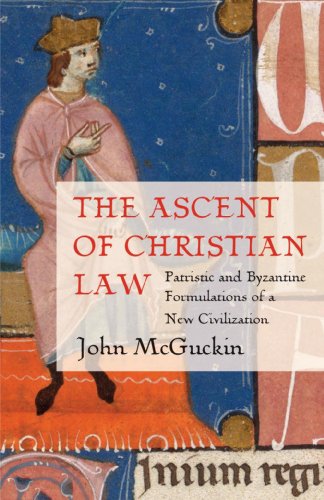
Book Review: The Ascent of Christian Law: Patristic and Byzantine Formulations of a New Civilization by John McGuckin


The Ascent of Christian Law: Patristic and Byzantine Formulations of a New Civilization
John Anthony McGuckin
St Vladimir's Seminary Press,U.S
ISBN: 978-0881414035
Price: £13.66 (Amazon)

Regardless of the recent influx of books on the development of Orthodox Tradition becoming available in English, the topic of the Canon Tradition remains an area which is sparcely covered in great detail. Most introductions to Orthodox Christianity will cover the Oecumenical Councils and definition of Canon but will not go much further in covering the vast history of the topic.

McGuckin has stepped in to fill this void and has done so in a manner suiting the complexity of the subject matter. The Ascent of Christian Law is a must for any student of Canonology or reader of the subject. The book is very readable, regardless of the depth of your understanding, and covers both East and West in great detail, starting with the scriptural foundations of the Canons. It then proceeds to pass through various phases in the development of the Canons before reaching its conclusion at the later Byzantine Canonists and their input to the Canon Tradition of the later Byzantine Empire.

The level of historical research put into the text also makes this book worth reading, as it puts the councils and Synods of the first millenium into the context of the tradition as a whole. This allows the reader to see why the council was needed and how it impacted the development of the Orthodox Tradition, rather than simply giving us details on the event itself.

One flaw I can see with this book is McGuckin's need to state his opinion in his footnotes, which can take away from the academic nature of the text itself. Some readers may be able to understand the innocent manner in which this is played out, but for others it can be offputting to see a footnote in academic text referring to those who hold a certain viewpoint as 'dummies.' Regardless of this slight hitch, the contents of the book in itself are beautifully covered in a way rarely seen in a book on this subject.

Overall, McGuckin  has filled in a black hole which has plagued the world of Modern Orthodox Academics for decades. He has covered the vast and complex topic of the Canons in a way which makes it easy to understand and relevant to the reader. This in itself is an accomplishment which few have achieved and makes the book a highly recommended piece of reading for anybody interested in the topic.

By Subdeacon Daniel

Monday, 9 September 2013

Indian Orthodox Heirarchical Liturgy

Here are some pics from the Liturgy this Sunday when His Holiness Baselios Mar Thoma Paulose II of the Malankara Syrian Orthodox Church visited the UK.

Copyright for all these pictures belongs to the British Orthodox Church


1. The Catholicos arrives.


2. His Holiness with His Grace Bishop Timotheus of the UK, Europe and Africa.


3. Me and some of the Indian Readers waiting for the service to start.


4. Mar Timotheus begins the service. With him are Fr Halie Maskel of the Ethiopian Tewahedo Orthodox Church and Metropolitan Seraphim of the British Orthodox Church (Coptic Patriarchate), so 3 Oriental Orthodox communities and 3 continents ware represented here.


5. His Holiness blesses those in attendance.


6.His Holiness censers the Church.


7. I had the blessing of holding the candle for one of the priests during communion (Over 500 people communed.)


8. The Heirarchs, Clergy and Diaconate picture


9. Me with His Holiness Baselios Mar Thoma Paulose II and Metropolitan Seraphim El Souriani.

Wednesday, 4 September 2013

Book Review: Sweeter than Honey: Orthodox Thinking on Dogma and Truth By Dr. Peter Bouteneff


Sweeter than Honey: Orthodox Thinking on Dogma and Truth
By Dr. Peter Bouteneff
ISBN: 978-0881413076
Price £6.58 (Amazon Kindle Store)

As a book which I picked up purely as a timepass during a recent trip to Trivandrum, Bouteneff's most commonly known work turned out to be a worthwhile investment and one which I finished before the plane even took off. I am a fan of Bouteneff's academically honest writings and accessable writing style, but this book can easily be read and respected by Theology readers across the spectrum.

The book comprises of two sections, one which deals with the Philosophical complexities of defining truth, the other with how the Church forms Tradition around this truth. Both sections are close to 100 pages long and comprise of readable bitesize sections amid longer chapters. This allows the book to be read at a steady pace and entire sections easily found for rereading and academic quoting without sifting through paragraph after paragraph.

The content of the first section, as previously mentioned, is centered around the question "what is truth" and tackles this from a Theological viewpoint, questioning the role of Revelation and scripture in the process of defining truth. This is a good place to start, since it adds to the experience by giving the reader the benefit of understanding what Bouteneff means by truth before entering into the discussion of the Dogmatic side of the book.

The second section is where Bouteneff gets into the real study of Orthodox Dogmatics, looking at the importance of Dogma and the study of theology. This section studies the reason for studying theology, and Church's motives in the development of the Canons and Doctrine. This is further split up into sections explaining why and how certain factors and contributors to the development of Orthodox Dogmatics emerged, making compelling arguments for everything from the Orthodox Exegetical approach to the veneration of the fathers and their works. He also make a compelling case for the polemical language used by the fathers, which demonstrates a fair and academic approach which allows the reader to understand the complexities of reading the fathers.

 As key factors in the understanding of the vitality of Tradition and Dogma to the Orthodox faith, the reasons for their development of the various areas of Orthodox Doctrine and key questions surrounding the,  are covered well by Bouteneff and in a way which is extremely inviting and readable.  Altogether, I could not recommend this book enough. Not only is Bouteneff's writing style one which invites the reader to continue and learn, but the way in which he tackles a topic which can be immensely dry with a vitality which can only be found in a writer who triely values the Traditions of the Orthodox Faith.

Structure and Synod in the Orthodox Tradition


General Structure

The Orthodox Church has no specific 'job titles' so to speak, though specific members of the Heirarchy will have specific titles according to their means. Here are some key examples and Explanations of terms.

Within the Eastern Orthodox Church there are 9 Patriarchs, with 6 Autocephalous Metropolitans who were granted Autocephaly over their various territories by the Patriarchates. Neither of these answer to a higher authority except for The Archbishop of Athens whose territories are partially under Constantinople.

There are six further Autonomous Archbishops/Metropolitans who have regional control over their territories, these were granted their Autonomy through one of the larger Churches and therefore cannot take the title of Patriarch as their head is appointed through another Patriarch.

(List Of Eastern Orthodox Heirarchs Here)

As well as this, within the Non-Chalcedonian Tradition there are 6 Oriental Orthodox Patriarchs/Catholicoi, with 4 Titular Patriarchs (and Catholicoi) holding Authority over specific areas but recognizing the Spiritual Authority of their Patriarch overall. The Oriental Orthodox community and Eastern Orthodox are not in communion, due to the Chalcedonian Schism of 451, though each retains its structure, with some cases of dual Patriarchs in the same place (Alexandria, Antioch, Istanbul/Constantinople, Jerusalem)

(List of Non-Chalcedonian Heirarchs Here)

Each Patriarch has authority over his Patriarchate, with no interference of others, though to make major decisions he would need the support of his Synod (Bishops in his Juristiction) and in many cases is expected to have support from the other Patriarchs, which is why the Orthodox Church does not have the changes in Doctrine in the way that other communities may.

Titles for heads of Jurisdictions
The head of a specific community will generally be called a Patriarch, Pope or Catholicos. 
Patriarch is the most common title for the leader of an Orthodox Community.
The term Pope originates in Egypt in the Patristic era and has been continued to be used by the Coptic Community rather than Patriarch. The Official Title of the Greek Orthodox Patriarch of Alexandria is also "Pope and Patriarch of Alexandria and all Africa" though he is commonly simply called Patriarch.
Catholicos means 'Of the Whole' and is used by the Georgian Church in the Eastern Tradition and Armenian and Malankara (Indian/Jacobite) Churches in the Oriental Traditions

Titles for Bishops
Within each Jurisdiction there are Bishops heading Dioceses or with an Administrative role. They will have Titles based upon their role and authority

Metropolitan Bishop/Archbishop was the highest Authority until the title Patriarch was created at Nicaea in 325. These Bishops can rank above or below Archbishops depending on the Tradition (Macedonia and Serbia hold Archbishops as higher, most others rank Archbishops lower). They have no specific power or direct authority over other Bishops, though have the right to oversee Synods and Councils due to their higher authority in the Church itself. 

Archbishop is the title for a Bishop of greater responsibility than other Bishops, He may not always hold a Diocese, as it may be a title for a administrative responsibility.

Bishop is the title given to the head of  Diocese. The title dates from Apostolic times and is present in the writings of St paul, as well as St ignarius the Apostolic, who stated that all must be done through the Bishop. a Bishop is traditionally a male monastic (Since the 6th Century) or Celibate Priest, who has a role over an administrative function or Diocese. until recent times, these were only Diocesan and could not be transferred between Dioceses (By the Nicene Canons they were seen as 'Married' to one) though in recent years in the Eastern Orthodox Church this has changed. A Bishop without a Diocese is called a 'Titular Bishop' in the Eastern Orthodox and 'General Bishop' in the Coptic Orthodox Church.

The Synod
The Synod is the group of meetings. Since Orthodoxy keeps its Conciliar Structure, they play a vital role in discussing issues regarding the jurisdiction.

By the Canons of Chalcedon, every Patriarchate must hold a 6 Monthly Synod meeting, this was later changed to yearly at Trullo. This is also existent in the Oriental Orthodox Church who only recognise the first three Ecumenical Councils as being truly Ecumenical. The Synodial meetings will often be attended by all Bishops in that Patriarchate, who will discuss issues as a whole with the Patriarch residing, also holding separate meetings in specific councils, regarding different matters which will be reported to the Synod as a whole after. Dioceses also hold yearly Synodial meetings to discuss matters within that Diocese.

Tuesday, 27 August 2013

Key components of the wedding service in the Malankara Orthodox Syrian Church (Indian Orthodox Church)


Key components of the wedding service in the Malankara Orthodox Syrian Church (Indian Orthodox Church)

- Picture from my wedding, descriptions by Fr Abraham Thomas of the Orthodox Theological Seminary, Kottayam.

The Rings
The Blessing of the Rings recalls the first detailed account of a wedding engagement in the Bible, in which Eleazor, commissioned by Abraham, places gold ornaments on Rebecca to mark her engagement to Isaac. The ring is a symbol of contract, placed on the bride and groom by the priest representing God and the Church.

The Crowns (Chains)
The Blessing of the Crowns is the central part of the marriage ceremony in all Orthodox Churches and culminates in the ceremony of coronation which symbolizes the bestowal of the crown of righteousness upon the couple. In the Indian Orthodox the crown is replaced by a chain placed around the neck of bride and groom by the Celebrant, though the premise is the same.

The Minnu (Thali)
In south India, the Thali used in a hindu marriage was in the shape of a leaf of the sacred banyan tree and Christians modified the Thali by superimposing a cross on the leaf. The Minnu is suspended on seven threads drawn out of the Manthradoki. The seven strands represent the bride, the bridegroom, the couple’s parents and the Church. The groom ties the threads around the bride’s neck – tying the knot. It remains there for one week until the Groom's mother cuts the thread, and the Minnu is moved onto a chain.

The Manthrakodi
the Manthrakodi, a sari presented by the bridegroom and his family, is draped over the bride’s head, symbolising the groom’s pledge to protect, care for and cherish his wife.

At this point, the bride’s relative, who has been standing behind her, yields her place to a female member of the groom’s family as a sign that the bride is welcomed into her new family.

Wednesday, 17 July 2013

Book review An Interpretive Account of Belief and Practice in the Ethiopian Tewahedo Orthodox Church. By Abba Haliegebriel Girma.


An Interpretive Account of Belief and Practice in the Ethiopian Tewahedo Orthodox Church.
By Abba Haliegebriel Girma.

ISBN: 97814820008791
Price: £7.16 (Amazon)
 
It is not very common to see a well supported overview of the Tewahedo Orthodox Tradition on major online book stores, especially written in English. Archimandrite Hailegebriel's book comes, therefore, as an unexpected gem amongst a large number of books trying to explain the tradition from an outside and anthropological viewpoint.

The layout of the book contains four sections which cover the structure, doctrines, sacraments and diaspora communities of the Ethiopian Tewahedo Orthodox Church. Considering that the book only spans around 80 pages this is a brave endeavour which generally succeeds in its attempt to give a summary of the Church's stances.

The use of evidence from Scripture and the Church Fathers to support the views is especially well achieved. Almost every aspect of the Faith which is covered in the book is backed up with a Biblical reference to prevent any possible controversy. Many are also placed with explanations from the Church Fathers or the Ethiopian Law of Kings to allow the historical development and practice of Liturgical and Sacramental actions.

Overall the book demonstrates a positive step from the Ethiopian Tewahedo Church, which is sometimes seen as academically lacking in comparison to other Orthodox communities. I would recommend the book to anyone who wants a Theological and Ecclesiological overview of the Church, as it is written for people with a reasonable level of Theological Literacy.

Do not expect an Introduction to the Ethiopian Tewahedo Orthodox Faith from the book, as it is not written for this purpose. If you are looking for a brief overview or reference source for the Tewahedo Tradition, this is certainly recommended. When it comes to Theological studies, It is possibly the best guide to Tewahedo Orthodox teaching apart from primary sources, so certainly something to have in your bookshelf.

Subdeacon Daniel

Sunday, 14 July 2013

We must not understand repentance as being something only for a period of time.


“We must not understand repentance as being something only for a period of time, or as one of the phases of life. We should rather take it as a complete way of life, life with God.” 
 
Fr Matta El-Meskeen