Showing posts with label history. Show all posts

Sunday, 19 February 2017

Book Review: Coptic Christianity in Ottoman Egypt By Febe Armanios


Coptic Christianity in Ottoman Egypt
By Febe Armanios
ISBN: 0190247223
Price: £17.27
Febe Armanios’ book is one that I had been looking forward to reading for (literally) years. Whilst writing my Mth Thesis on the development of the Coptic Papal Election system one of the great difficulties was a lack of academic writing on the Coptic community during the Ottoman Era, and this text fills in the gap nicely, using sources from both Ottoman and Coptic records to give a broader understanding of the historical period and the community relations therein.

Armanios’ writing takes a thematic approach to the topic, looking at specific themes and historical instances during the Ottoman Era in Egypt in order to gain an insight into the place of the Coptic Church in society as well as the allowances and practices of the community in the Ottoman yoke. The text starts with a look at the sources available to us to do this, and raising the issue of lack of available sources to academics. It goes on to look at martyrdom stories and their impact on the community, pilgrimage and the development of rights and finally to cover the use of sermons to define Coptic identity during conflicts with missionaries from the Catholic and Protestant communities.

The structure of the text and its great insight into a very loosely explored period in Coptic history allows this book to demonstrate some great and original research into themes which have not been looked at. As well as this, Armanios’ approach to the topic and the readability through which she expresses her research allows the reader to access a vast historical landscape in an easy manner. This readability and originality makes Armanios’ book a great read and certainly one to be recommended to anyone with an interest in Coptic history or general Ottoman studies.

As for any weaknesses, the main one is one which Armanios herself addresses in the book. In the introduction she states that due to prejudices with regards to the period and a general lack of scholarship as to Coptic communal history the text can only give a broad overview of the period without delving into any of the subjects in further detail. Therefore to any specialist reader looking into a certain aspect of Coptic history or Ottoman history in Egypt it can seem too loose in areas, though this is not the fault of the writer but simply a symptom of a lack of academic resources available.

Overall, I thoroughly enjoyed the book. As mentioned, it is readable and original in its scholarship which allows it to be a text with a lot to offer the reader. I would recommend it to anyone looking to fill in this much misjudged gap in Coptic Historical studies and anyone with an interest in the development of modern Coptic society generally.

Wednesday, 15 June 2016

Book Review: Christianity in the Land of the Pharaohs by Jill Kamil


Christianity in the Land of the Pharaohs
By Jill Kamil
ISBN:
RRP: £34.99

Jill Kamil’s “Christianity in the land of the Land of the Pharaohs is a book I picked up last year on a visit to the AUC in Cairo. Having finally gotten the chance to read it through, I found it a very interesting book and a change from the usual texts on Coptology and Egyptian History due to its change in focus from the Church and its teachings to the people of Egypt themselves. As a text on the history of the Coptic Orthodox Church it avoids any of the traditional trappings of selling itself as an apologetic for the Church and looks at the links between Egyptian Culture and the Church’s development. This is both quite refreshing and somewhat frustrating for the reader.

The book is structured in a way that gives the history from the visit of the Holy Family to the modern times. The Chapters consist on various historical instances, such as the rise of monasticism, the legalisation of Christianity, the Chalcedonian Council, Roman Persecution and the rise of Islam. These all allow for the book to flow in a way that creates a clear narrative, however this is sometimes confused by tangents from the author which can at times disjoint the flow of the text. The book ends with a look into the future of the text, in which the author praises the conversation of Icons in monasteries and the revival of this practice, demonstrating the preservation of many of the aspects covered in the book today.

In a way, this book is a breath of fresh air, since it takes a very novel approach to the history of the church. It does this by avoiding dwelling on any of the traditional Theological aspects which many would fawn over it looks at the Church as the Christian people of Egypt. In the same way, it has a brilliant analysis of Egyptian monasticism as a phenomenon within the cultural scape of Egypt. This allows the book to sell itself as a purely historical endeavour, making this clear from the start when it makes a historical link between the worship of Isis in the Middle-Kingdom and the strong veneration of the Virgin Mary. This is a rare and often side-lined focus, though in the case of this text it marks as a marker for the way in which the book will flow into a demonstration of the development of an ‘Egyptian Style’ of Christianity. 

In the same way, the nationalistic tendencies of the text are also its downfall. Rather than the book being a history of the development of Orthodox Christianity in Egypt it retains far too prominent a focus on the Egyptian cultural element as opposed to the Church itself. This can often be a frustration to the reader, as it forces them to endure a 5 page link to pagan practices in pre-Christian Egypt followed by an explanation of how the Christian idea is superimposed onto this. I feel that, when reading from a Christian stance, it damages the book as a text on the history of the Church as it almost implies that the cultural element is more important than the Church itself.

So, would I recommend this book? Yes, to some extent. I would certainly recommend it to anyone interested in a cultural history of Egypt and understanding the influence of its ancient past on the development of Coptic Civilisation. In the same way, I would advise it to anyone interested in the development of Coptic culture and the Church as a ‘national church.’ On the other hand, I would not advise the book for someone looking into the development of the Church from an Orthodox perspective, though I feel that this is not what the book was designed for. Overall, a good and interesting Cultural history book, though not for someone seeking a text on the Church itself.

Tuesday, 28 April 2015

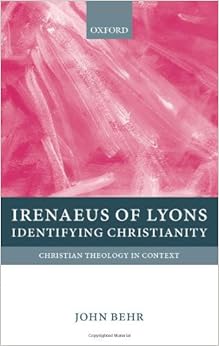
Book Review: Irenaeus of Lyons: Identifying Christianity By Fr John Behr


Irenaeus of Lyons: Identifying Christianity
By Fr John Behr
Saint Vladimir's Seminary Press (2015)
ISBN: 0199214638
PricE: £18.99 (Amazon uk)

Being a Philosophy teacher, I run discussions and evaluations into ‘The Theodicy of Irenaeus’ on a regular basis and when I do so, it is always interesting to discover that those who write of this Theodicy know little to nothing of the Saint himself and tend to echo more the works of John Hick and other modern thinkers who appropriated what they saw as the works and ideas of Irenaeus.

Dr John Behr’s work on St Irenaeus came highly recommended as an introduction to the life and work of this saint, who has suffered a great deal of neglect through the years due to being deemed as irrelevant to the later theological debates by early modern writers and as a mere polemicist by the more liberal voices in modern Theology. It is for this reason that such research as that of Fr John Behr opens his life and work up to further research in a fair manner, without simply using this Saint as a sidenote in a larger discussion.
The book begins with an overview of the life of St Irenaeus and the place of his work within the wider context of the Roman Christian community at the time. This section is extremely detailed and beneficial to understanding the life of Irenaeus and his relationships with other Christian groups and writers of the time The structure of this section allows for readability, splitting into sections to describe the various players in the roman stage as well as Irenaeus’ interactions with them. This allows the reader to come to grips with what was a highly complex and fragmented community at the time.

Following this detailed overview, we are treated to an in depth analysis of the first 2 books of Irenaeus’ most known text, Against Heresies. In this section, Fr John Behr opens this famed work and breaks down its structure in a way that allows the reader to understand its natural flow. This is supported with excerpts from the text itself and an explanation of any irregularities or ambiguities therein. After this section the same is done with the last 3 books, demonstrating the natural split within the text. Both of these sections contain detailed Theological analysis of the text and its context, as well as a fair review of the work as a piece of personal writing which allows us a greater understanding of Irenaeus himself as a Christian writer of his period.

The book ends with a conclusion in which Fr John Behr demonstrates his passion for Saint Irenaeus and emphasises his importance in our understanding of the development of Orthodox Christianity and the Roman Christian community of its time. It is at this point that you really come to grips with the text and just how underplayed the Saint has been with regards to his role in identifying Christianity and its progression.
A key strength of the book lies in the depth of Fr John Behr’s analysis into the life and work of St Irenaeus. One only needs to look at the author’s previous writing to see that this is Fr John’s labour of love. The text itself contains a myriad of key historical and theological points which are brought to light in the way that only someone who knows and appreciates his topic can do. This made the book thoroughly readable on a personal level, as it brought the Roman Christian life and the works of Irenaeus to life and caused me to forget at times that I was reading a contextual study of a 2nd century Christian writer.

 A down side that I would put on this text is that it is not a light read. Though extremely readable to someone who understands the historical context of the work, it could not be recommended to someone who simply wishes to know about St Irenaeus. This point is a fairly obvious one due to the text being labelled ‘A contextual study’ though it needs to be said that the text looks at this context at such a depth that someone simply looking to find facts about Irenaeus may well miss them. 

Overall, I would recommend this text to anyone with an interest in the period or who wishes to take on the works of Irenaeus with a suitable guide to assist them on every step of the way.

Monday, 12 May 2014

Review of The Orthodox Church in the Arab World, 700 - 1700: An Anthology of Sources by Samuel Noble & Alexander Treiger


Review of The Orthodox Church in the Arab World, 700 - 1700: An Anthology of Sources
By Samuel Noble & Alexander Treiger
ISBN: 0875807011
Price: £24.50

There are many introductions to Orthodox Christianity available in the English language today, covering the vast history of the Church and quoting various saints and sources to support their position. The most famous of these is Metropolitan Kallistos’ The Orthodox Church, which covers both the history of beliefs of the Church in a way which covers all key elements. Though even his books has a flaw, which Samuel Nobel addresses in the Introduction to The Orthodox Church in the Arab World. As Noble states, “The Chapter Entitled ‘The Church under Islam’ begins with the Ottoman conquest of Constantinople in 1453, with not the slightest hint that three Patriarchates had been under Islamic domination for more than eight centuries prior to that date.” And Noble highlights the same issue with various other texts.

It is in this respect that Noble and Trieger’s text comes as a breath of fresh air to any reader with an interest in reading about the experience of Christians in the Arab world before the 16th century. Noble has been able to collect and translate a collection of texts spanning the 1000 years between 700 and 1700, giving a sense of a diverse experience and collection of genres of writing produced by Christians in the Arab world during this time.

In my view the book is a great stride in out understanding of the experience of Arab Christians in the Middle Ages, with such texts as The Disputation of the Monk Abraham of Tiberius and Paul of Antioch’s Letter to a Muslim Friend demonstrating the interaction between the Christians and Muslims of the time, as well as other texts showing the forms of Apologetic technique being used, including the use of the Qur’an by Christian clergy to debate Muslims and explain the Orthodox faith in terms which they could understand. Noble’s translation of these texts allows for this experience to come to light for the first time and, in doing this, opens up a field of analysis of this intercultural dialogue at a time when Christian-Muslim relations are a heated topic in the context of the MENA region.

A weaker point of the book is the lack of analysis of relations in areas such as Egypt and the non-Chalcedonian Orthodox tradition, largely due to the author’s area of study being based around the Chalcedonian Orthodox community. This means that the book does not allow for a study of relationships between the two Orthodox communities in the Middle East at the time, though the stud of the Coptic Community in the context of the various caliphates has been an object of study by Medievalists and Egyptologists over the years already. 

In conclusion, Noble’s text provides a rare and wonderful glance into the Orthodox Church in the Arab World and fills a long neglected void in Scholarship regarding the Christians of the Middle East and the Arabic Christian community. The translation of these texts also allows for a peek into the various interactions between Christian and Muslim in these areas and the fascinating apologetic tradition which emerged from this. Noble has done a great service to Christian Scholarship in producing this text, which will hopefully open the eyes of others to this untapped area of study.