
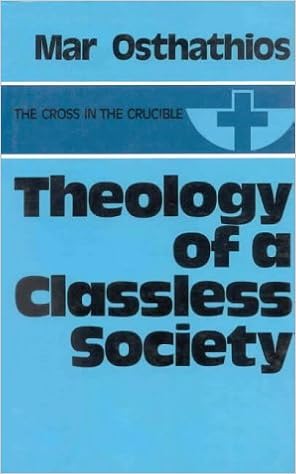
Theology of a Classless Society
By Dr. Geevarghese Mar Osthathios
ISBN: 0718824156
Price: £89.95 (Amazon UK Marketplace)
By Dr. Geevarghese Mar Osthathios
ISBN: 0718824156
Price: £89.95 (Amazon UK Marketplace)
I had been planning to buy and read this text for a number
of years to have a further understanding of Mar Osthanasios’ political
philosophy and his theological justification of it. Since in the summer I was
visiting Kerala, I thought to take the opportunity to read this text since it
is seen as one of his most famous works. As well as this, the text is often
cited as an important English language work from the Indian Orthodox,
especially with regards to concepts of social justice. With these in mind, I felt
it important to read and understand.
The book is presented as an explanation of Mar Osthasios’
theory of the possibility of a classless society, demonstrated as Christian through
use of theological examination with plenty of reference to the coequality of
the trinity and Christ’s teachings on community. It is divided up based upon
themes, from the outline of the theory, its application, to its theological
justifications, with most of the book dedicated to the theological
justification. Following on from this, Mar Osthasios gives a short question and
answer section of the theory as well as a justification for his trinitarian terminology
use which he states in the text as controversial.
Though I struggle with the premise of the book, a good
strength of it is its resourcing. Mar Osthasios, having been educated under
some of the most prominent Orthodox thinkers and secular philosophers of our
time, puts a great deal of research into the sourcing and referencing of his
work to support his theory. As well as this, the importance placed on the
justification of his theory gives the book a sense of respect since regardless
of your view on the theory you can sense the passion of the writer and it often
draws you in. Though both of these are important points, I feel the greatest
strength of this book is the writer’s awareness of the issues which people
could raise with his theory. There is no sense of arrogance in the text, which
is a rarity in political theology and many theological text. Mar Osthasios
knows some people will scoff at the idea or at his theory’s application but
wants you to know why he believes it.
The major difficulty for me with this text lies in the
theory itself and the way it is displayed. Though I admire the rigor and
passion of Mar Osthasios in presenting his theory, I still feel that it is
simply presented as a Christian Communism and is drawn too much on his
admiration of communism as opposed to the theological and ecclesiological
foundations it is claimed. An example of this comes in his ideas of
application. He often compares his view to Liberation Theology and throughout
the text he states his admiration for key thinkers of the movement without addressing
its issues Theologically. He also states that he does not see communism as an
answer since it is secular, however he then speaks in praise of Mao for being
used by God as a tool to develop ideas of a classless society, comparing him to
God’s use of Cyrus for the return of the Jews from exile without justifying the
false equivalence here.
The problem with this is that the Theological aspect seems
to be simply a coating for the theory rather than its foundation, as
demonstrated in his tracts on Jesus’ life and its links to a classless society,
which would have given a perfect opportunity to evaluate the communist links in
a more theological level but instead leaves them uncontrasted apart from the
general “but that is secular” comment. As well as this, the Theological
examples used are often vague and even risking heresy, which Mar Osthasios even
admits when addressing his almost tritheistic view of trinity. To me this makes
the book suffer greatly, since it slowly seems to reveal itself as less of a ‘Theology
of a Classless Society’ and more of a ‘View of a Classless Society with a dash
of Theology.’
Overall I would say that the text is a good one for looking
at how Christian thinkers have attempted to address the issue of clearly unfair
social practices and problems they have faced, however I cannot recommend it as
a viable foundation to a theory of political theology since it fails to address
a number of issues both theologically and politically which I feel undermine
the theory and make it appear a simple communist text with a light coating of
theology, one which has been seen in the past and has not seen itself aligned with
the Ecclesiological or Theological standings of the Orthodox Church.


