Showing posts with label russian. Show all posts

Saturday, 26 March 2016

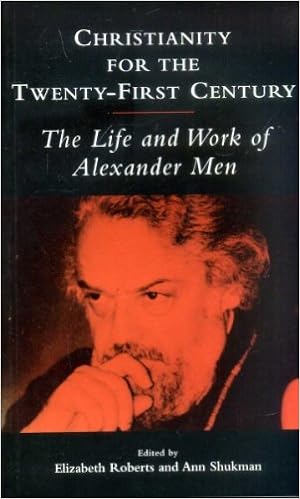
Book Review: Christianity for the Twenty-First Century: The Life and Work of Alexander Men


Christianity for the Twenty-First Century: The Life and Work of Alexander Men
Edited By Edith Roberts and Ann Shukman
SCM Press Limited, 1996

ISBN: 033402613
Price: £12.95

During the early part of my journey to Orthodoxy when I have struggled to reconcile my faith with my wider life, two great modern thinkers that have helped me through their works are Metropolitan Anthony Bloom and Fr Alexander Men. Both have a way of explaining issues in a way that resonates with the western mind, especially with those versed in the writings of modern French and German philosophers. Though the works of Metropolitan Anthony seem to appear on bookshelves across the world there is little available in the English language by Fr Alexander. It was therefore a great blessing to discover this small collection of his articles, talks and essays in a London bookstore only a few days before the start of lent.

The text is split into three sections, one on Christianity in general, another on Russian Christianity and the third giving a summary of where Christianity was seen to be heading at the time. This structure allows the reader to see the overview of the problems facing Christians in the modern world, along with the specific example from Fr Alexander’s context as well as the solutions and ideas put forward by Fr Alexander as a way of dealing with the problems and ending with the talk which Fr Alexander gave on the night before his death. As well as this structure providing a useful narrative to the collection, it also serves as a way to understand the ideas and thoughts of Fr Alexander better, letting us see the world which he faced during his life and to see how he wished to help those struggling in this. 

The first section’s articles speak much on Fr Alexander’s views regarding issues such as suffering an state Churches. Fr Alexander was seen as a controversial figure by many due to these positions, with many accusing him of extreme ecumenism and others speaking out against his opposition to state churches. The articles in this first section provide a fascinating insight into the arguments he put forward with regards to this. The second of these looks at the specific situation in Russia following Perestroika. In these interviews and articles we see Fr Alexander addressing the struggle of returning to spirituality and the ‘problem of choice’ faced by many Russians. These demonstrate the challenges that Russia in regaining its identity after the fall of the Soviet Union and Fr Alexander’s willingness to work to address this. The third section provides a summary of the vision for the future and contains the talk which gives the book its name. These give an idea of what Fr Alexander saw as the solution to the aforementioned problems.

As mentioned previously, I see the books structure as one of its biggest strengths. It gives us a good overview of Fr Alexander’s life and works in a meaningful way. As well as this, I would say that the book’s other key strength comes from the content itself. Fr Alexander Men was an extremely thoughtful and prevalent writer during his life, and though I am reviewing this specific collection it is important to really point out that the writings themselves are extremely well thought out. Fr Alexander’s use of western Philosophical writings to express ideas and his love for the Eastern Mystical tradition both shine through in these works, giving us a real insight into how much of an important figure Fr Alexander was. The choice made in the writings allows this to come through with the context of early nineteen-nineties Russia giving them their setting.

Unfortunately, this focus on the context can also be seen as the weakness of the text. Fr Alexander wrote close to ten books on Christian thought in Russia, as well as various theological texts covering exegesis and Christology. The book’s preoccupation with Fr Alexander’s more political writings gives the image of a man whose only real focus was on this situation and plays Fr Alexander as more of a political figure than he really was, this is not helped by the ominous red figured cover, which again paints Fr Alexander in this light. The writer explains in the introduction that a complete summary of Fr Alexander’s work is “a task for another time” but still suggests that the selection is a broad one which is a claim I disagree with.  I feel that more of an introduction to Fr Alexander as an Orthodox thinker would be needed for the text to really give a feel for his prominence in this field.

Overall, the book was a good one to start the Lenten fast. It served to remind me that in a world where many call themselves Christian for a national or political identity we should look more at ourselves and see that our lives are spent in a prayerful search for the true meaning of this identity and that we should not take half measures or rely on some kind of national tribalism to make our way easy as it should never be an easy path to live.

Monday, 4 May 2015

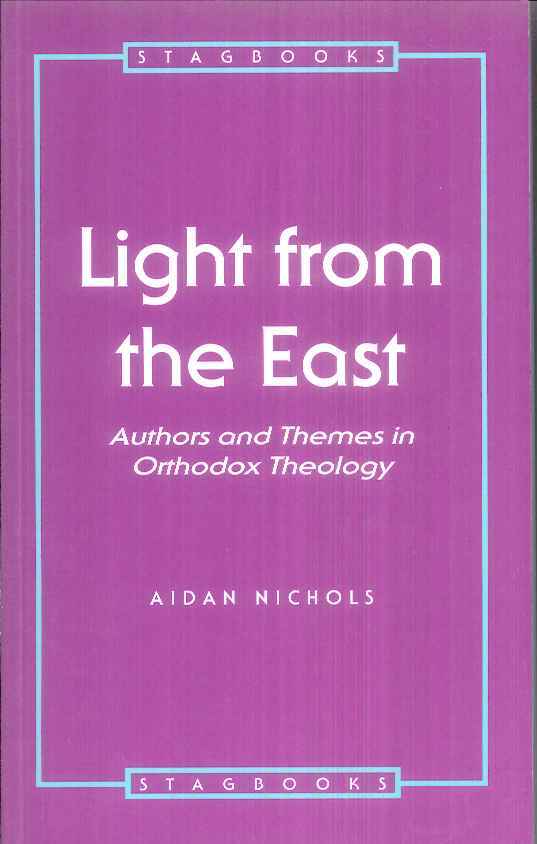
Book review: Light From the East By Aidan Nichols


Light From the East
By Aidan Nichols
Continuum Books (1995)
ISBN: 072205081X
Price: £34.99 (Amazon UK)

Review By Deacon Daniel Malyon (British Orthodox Church)

There are a number of books which track the development of Eastern Orthodox thought in the 20th Century, though usually these are focused on a singular concept or theme. In Light from the East, Aidan Nichols has removed this thematic element to allow for a broad overview of the major players in the 20th Century Orthodox Theological world and allowed for these themes and ideas to be explored in a wide-ranging collection of thinkers.

The text explores the key works and ideas from well-known modern Orthodox Theologians such as Vladimir Lossky, Sergei Bulgakov, Nicholas Afanasiev, Georges Florovsky amongst others. In each of these sections there is a short biographical passage, explanation of the context in which the thinker emerged, coverage of ideas and an evaluation of the key development with which the thinker is most associated. This makes the text somewhat unique as it is based organised in a fashion which emphasises the specific person and not their idea. This also allows for a deeper exploration of the development of these ideas throughout the life of the writer as opposed to simply addressing it is a simplistic form.

The book would be of some use for someone (such as myself) with some grasp of the seminal works of the thinkers covered but who wishes to get to grips with the development of Eastern Orthodox thought in the past century as a whole. This is because of the structure above all, which I have already praised for its focus on the context as opposed to simply the ideas. In this way the book demonstrates a positive growth in the level of ecumenical research being carried out by thinkers in the west and makes the text praiseworthy for that significant step in both an academic and ecclesiological sense. 

In the same way, this academic structuring of the book is a weakness, as the evaluation section seems to depend on decontextualizing the idea and dissecting it through means of a western approach. When looking at such ideas as the radical apophatic theology of Lossky, this approach seems to undermine the very essence of that apophatic thought by tackling it through means of analytic thought. In this way, the criticisms levelled by the author become irrelevant to an Orthodox reader who simply wishes to look into the developments from within his/her own tradition.

Overall, I would recommend this text to anyone who wishes to get to grips with the various and somewhat divergent schools of thought of Eastern Orthodox Theology in the 20th Century. It gives a great overview of the various thinkers involved as well as the way in which their ideas were formed, allowing for a broader explanation of these developments than many other texts would allow.


Wednesday, 4 September 2013

Structure and Synod in the Orthodox Tradition


General Structure

The Orthodox Church has no specific 'job titles' so to speak, though specific members of the Heirarchy will have specific titles according to their means. Here are some key examples and Explanations of terms.

Within the Eastern Orthodox Church there are 9 Patriarchs, with 6 Autocephalous Metropolitans who were granted Autocephaly over their various territories by the Patriarchates. Neither of these answer to a higher authority except for The Archbishop of Athens whose territories are partially under Constantinople.

There are six further Autonomous Archbishops/Metropolitans who have regional control over their territories, these were granted their Autonomy through one of the larger Churches and therefore cannot take the title of Patriarch as their head is appointed through another Patriarch.

(List Of Eastern Orthodox Heirarchs Here)

As well as this, within the Non-Chalcedonian Tradition there are 6 Oriental Orthodox Patriarchs/Catholicoi, with 4 Titular Patriarchs (and Catholicoi) holding Authority over specific areas but recognizing the Spiritual Authority of their Patriarch overall. The Oriental Orthodox community and Eastern Orthodox are not in communion, due to the Chalcedonian Schism of 451, though each retains its structure, with some cases of dual Patriarchs in the same place (Alexandria, Antioch, Istanbul/Constantinople, Jerusalem)

(List of Non-Chalcedonian Heirarchs Here)

Each Patriarch has authority over his Patriarchate, with no interference of others, though to make major decisions he would need the support of his Synod (Bishops in his Juristiction) and in many cases is expected to have support from the other Patriarchs, which is why the Orthodox Church does not have the changes in Doctrine in the way that other communities may.

Titles for heads of Jurisdictions
The head of a specific community will generally be called a Patriarch, Pope or Catholicos. 
Patriarch is the most common title for the leader of an Orthodox Community.
The term Pope originates in Egypt in the Patristic era and has been continued to be used by the Coptic Community rather than Patriarch. The Official Title of the Greek Orthodox Patriarch of Alexandria is also "Pope and Patriarch of Alexandria and all Africa" though he is commonly simply called Patriarch.
Catholicos means 'Of the Whole' and is used by the Georgian Church in the Eastern Tradition and Armenian and Malankara (Indian/Jacobite) Churches in the Oriental Traditions

Titles for Bishops
Within each Jurisdiction there are Bishops heading Dioceses or with an Administrative role. They will have Titles based upon their role and authority

Metropolitan Bishop/Archbishop was the highest Authority until the title Patriarch was created at Nicaea in 325. These Bishops can rank above or below Archbishops depending on the Tradition (Macedonia and Serbia hold Archbishops as higher, most others rank Archbishops lower). They have no specific power or direct authority over other Bishops, though have the right to oversee Synods and Councils due to their higher authority in the Church itself. 

Archbishop is the title for a Bishop of greater responsibility than other Bishops, He may not always hold a Diocese, as it may be a title for a administrative responsibility.

Bishop is the title given to the head of  Diocese. The title dates from Apostolic times and is present in the writings of St paul, as well as St ignarius the Apostolic, who stated that all must be done through the Bishop. a Bishop is traditionally a male monastic (Since the 6th Century) or Celibate Priest, who has a role over an administrative function or Diocese. until recent times, these were only Diocesan and could not be transferred between Dioceses (By the Nicene Canons they were seen as 'Married' to one) though in recent years in the Eastern Orthodox Church this has changed. A Bishop without a Diocese is called a 'Titular Bishop' in the Eastern Orthodox and 'General Bishop' in the Coptic Orthodox Church.

The Synod
The Synod is the group of meetings. Since Orthodoxy keeps its Conciliar Structure, they play a vital role in discussing issues regarding the jurisdiction.

By the Canons of Chalcedon, every Patriarchate must hold a 6 Monthly Synod meeting, this was later changed to yearly at Trullo. This is also existent in the Oriental Orthodox Church who only recognise the first three Ecumenical Councils as being truly Ecumenical. The Synodial meetings will often be attended by all Bishops in that Patriarchate, who will discuss issues as a whole with the Patriarch residing, also holding separate meetings in specific councils, regarding different matters which will be reported to the Synod as a whole after. Dioceses also hold yearly Synodial meetings to discuss matters within that Diocese.

Monday, 12 November 2012


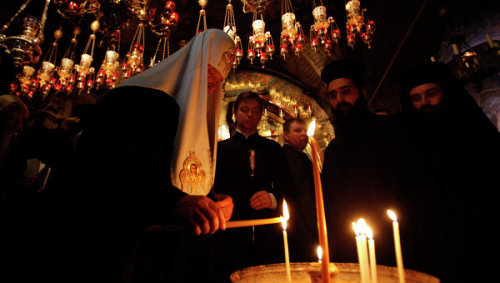
Patriarch Kirill of Moscow and all Russia prays before conducting a liturgy in the Church of the Holy Sepulchre in Jerusalem as part of his visit to Palestine.